
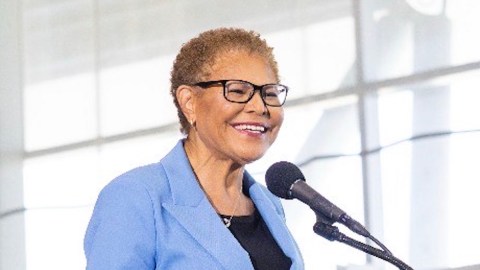
With just a few days left until the primary elections, the result of the primary race for mayor of the city of Los Angeles is uncertain. Polls show that none of the candidates will receive 50% plus one of the votes, which will mean that the first two will face each other in November.
40% undecided, 44% among Latinos
Leading the polls are incumbent Karen Bass, reality TV star Spencer Pratt, a conservative Republican who became a civic figure after losing her home in the devastating Palisades fire, and District 4 Councilwoman Nithya Raman. Between them they divide half of the voting intention. Ten percent goes to a large pool of self-employed candidates. And the rest? Those who don’t know who they will vote for. That’s the biggest block.
Yes, Bass is leading in the polls, but with unusually weak numbers.
A March 29 FM3 study for the UCLA Luskin College of Public Affairs shows Bass leading with 25% of voting intentions, with 11% for Pratt. Another poll, from mid-March by the University of California Berkeley for the Los Angeles Times, gives Bass the same percentage; Raman follows with 17%. Finally, Emerson College’s for Nexstar Media Community, completed March 9, gives Bass 20% and Raman 10%.
These results show not only little enthusiasm for the mayor’s re-election but also a high proportion of undecided people: 40% do not know who they will vote for. Among Latinos, it is worse: 44% are undecided.
Among white, Latino, and Asian and Pacific Islander respondents, Bass has fewer voters than undecided voters. The only bloc that seriously supports Bass is the African American.
And that’s just days away from the elections. In fact, we are already voting by mail.
Is this common? No, says Zev Yaroslavsky, director of the Los Angeles Initiative and Los Angeles leader for decades. “It is unusual that 40% of likely voters are unsure of their choice…Mayor Bass faces the most challenging re-election for a sitting mayor in decades.”
Relative weakness
Bass’ relative weakness is striking and should be a red flag. He has to recover that diluted support. And the resource to recover is the Latino vote.
Could Bass lose? The possibility exists. This is demonstrated by the failure of Sam Yorty’s reelection in 1973 against Tom Bradley and James Hahn in 2005 against Antonio Villaraigosa.
But Villaraigosa’s rise was a source of rejoicing. Technology is based on the historical progress of the Latino community, which for the first time exercised its electoral force and sent one of its own to Metropolis Hall. The Hispanic electorate had mobilized like never before.
This time we are seeing a problematic process. A failure in his re-election process will be a historic setback.
Los Angeles under Bass has suffered serious setbacks and setbacks. The blows accumulated. These attacks have been faced since 2022.
The plagues of Los Angeles
COVID: The aftermath of the COVID epidemic was experienced, which hit the city during Eric Garcetti’s mayoralty, with its 36,000 deaths in the county, mostly in the city of Los Angeles.
Homeless: Between 2022 and 2025, the city of Los Angeles dedicated $4.29 billion to the homeless. But the numbers didn’t go down; On the contrary, they rose relatively: 41,980 in 2022, 46,260 in 2023, forty five,252 in 2024 and 43,699 last year, according to the Los Angeles Homeless Services and Products Authority (LAHSA). The solutions grew, but there are many new poor people.
Affordable housing: Since Bass took over, the situation has frankly gotten worse. The production of housing construction permits fell, from an annual average of more than 13,000 between 2015 and 2022 to 11,311 in 2023; 8,706 units in 2024 and 5,697 in part of 2025, 11% less than the same period in 2024.
And while thanks to an executive order Bass signed shortly after taking office, the Planning Department greatly increased plans for affordable units, the plans are not houses built, and the gap remains unclosed.
Taxes: In November 2022, city voters approved Measure ULA, an appreciable tax on home sales valued at $5 (4% of value) to $10 million (5%). Los Angeles raised $703 million, but less than a million was invested in affordable housing, far less than the administrative expenses to maintain revenue.
Fires: The historic fires throughout last January claimed 30 or more lives, forced more than 180,000 people from their homes, and destroyed more than 16,000 structures, at an incalculable cost that continues to fluctuate to this day.
Raids: Los Angeles, with an immigrant population of more than four million immigrants in its metropolitan area, has been a popular target of Trump’s anti-immigrant policy, both in his first term and obviously especially in his current one. The current immigration raids began since Trump took office on January 20, with armed, masked and anonymous federal agents traumatizing the community. Massive protests came, and that same month and for six months, 4,800 National Guard soldiers and more than 700 Marines patrolled our streets in response.
In December 2024, the city council approved and Karen Bass signed the declaration of Los Angeles as a sanctuary city for immigrants. The regulations prohibit the use of municipal resources for the enforcement of federal immigration laws.
Like any other official who had to face these problems, the result has been that Bass has lost popularity. She was blamed for these problems, regardless of whether it was fair or not. Now, he has to overcome adversity.
The truncated growth of the Latino community
Since Latinos began to compare their population growth with their electoral participation, their vote became more popular. In 2022 the Latino vote was 25%-30% of the total. That’s when Bass won.
His winning coalition was complex. It included white liberals from the city’s west side and progressive Asian voters. Hispanic leaders such as Senator Alex Padilla, union leader Dolores Huerta and Villaraigosa himself, among others, supported Bass.
But the Latino vote was at stake until the end.
A week before those elections, a survey by J. Wallin Thought Be Taught predicted that 43.7% of Latino voters would support his rival Rick Caruso and only 29.4% would support Bass. But when push came to shove, Latinos overwhelmingly favored Bass.
Finally, then-congresswoman Karen Bass won with 55% of the votes and a record-breaking number of voters. The last-minute Latino vote: that difference was what gave him victory in a campaign that seemed lost.
A vote of confidence that helped him navigate the murky waters of our politics.
Now, only 29% of Latino voters are prepared to vote for her, but not because they prefer another candidate, but because they are really undecided.
Latino Angelenos have been on the hardest side of all these historical shocks. In fact, ours looks like a community in retreat, licking its wounds, and it would not be surprising to have a percentage of voters that is imperfect compared to the last electoral cycles.
The October 2022 debacle
Now, in 2026, the absence of a Latino mayoral candidate is striking, and is symptomatic of the crisis in the city’s Latino leadership, the result of the October 2022 scandal that ended the political careers of three Latino councilors and a Latino union leader. Racist epithets used against an African-American child led to the acephaly of Latino leadershipstopped its historic progress and generated discontent, not only in the African-American community, but in practically all Angelenos. For months, thousands demanded that those council members resign. Although each of them reacted in a different way, without losing hope of recovering, they never did. With this unfortunate episode we realized that identity politics fail when they are inserted into a system that still harbors, accepts and develops racism.
Three days after the details of the conversation between the politicians became known, commentator Gustavo Arellano said: “But this ruins politics—especially Latin political power—for years, if not for a long time.”
Those of us who were attentive at that time to the political progress of the community understood it this way.
In that catastrophe that they brought upon their own heads, Latino leaders saw the collapse of an environment that had stopped recognizing them as the wunderkind of California politics. But it was not only them who were affected, but the entire scheme of an ascending Latin leadership and a strong and victorious coalition. That belief became an illusion.
Consequence: 2026 has arrived and there is no viable Latino candidate who can receive the support of a community that constitutes 50% of the residents of this city.
The challenge then is for undecided Latino voters to understand that a vote for Karen Bass is not a vote for the continuity of the problems but, on the contrary, for a solution whose foundations have been being built. It’s Bass’s turn. She must convince them that theirs is a vote for those who are capable of resisting and fighting to get ahead.


