
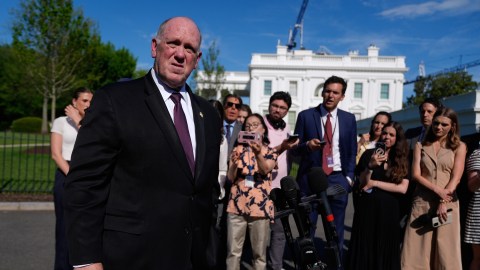
The president’s government Donald Trump would be in talks about an idea to allow certain undocumented immigrants to obtain a Green Card and, eventually, apply for citizenship, according to the border czar, Tom Homan.
The official’s revelation occurred in an interview with CBS News, with journalist Camilo Montoya-Galvez.
“I know the president is speaking with several members of his cabinet. There are conversations going on,” Homan said. “I’m involved in some and not in others, but I’m not going to get ahead of the president on this.”
There is no precision about what a project to regularize undocumented immigrants would be like, who it would benefit or under what conditions, since since his first term, President Trump has been against temporary protection programs.
However, President Trump has recognized that his immigration operations against undocumented immigrants have impacted key sectors of the United States economy, such as agriculture, which unleashed pressure from farmers.
“I want to work with them,” he said in August 2025 in an interview on NBC News. “We cannot allow our farmers to be left without anyone. These people are very difficult to replace. People who live in inner cities don’t do that work. It just doesn’t do it. And they have tried, we have tried. Everyone has tried it. They don’t. These people do it naturally.”
This pressure occurred since the beginning of 2025, when the Immigration and Customs Enforcement Agency (ICE), supported by the Border Patrol, which depends on the Customs and Border Protection (CBP) office, began operations with massive arrests that extended to California, Florida, Illinois, Georgia, Tennessee, Texas, Minnesota, in addition to New Jersey and New York, affecting agricultural workers and workers in other industries, such as construction.
“It is intuitive for my fellow farmers to also know that this clumsy immigration enforcement action by this administration only adds another layer of uncertainty to the environment created by the tariff debacle, the lack of real new trade agreements to market my corn and soybeans, and the continued increase in the cost of inputs to do business on the farm,” lamented Chris Gibbs, president of Rural Insist USA and Rural Voices Network, at a virtual conference last August.
The Dignity Law
If President Trump wanted to push for immigration regularization through Congress, the only bipartisan project is the so-called Dignity Law, presented by Representative María Elvira Salazar (Florida), co-sponsored by Democrat Tom Suozzi (New York), but which among the other 38 congressmen who support it includes the president of the Congressional Hispanic Caucus (CHC), Adriano Espaillat (New York).
The project, however, has not managed to advance in Congress and at a conference held in New York, in response to a specific question from this newspaper, Congresswoman Salazar acknowledged that the project could really advance if Trump joined it.
“The next steps are basically that the president [Donald] Trump understands that this is legislation we need and that this is given the green light so that the federal Congress knows that once we pass this legislation, he will sign it,” Salazar acknowledged.
The congresswoman’s office was asked if she has been integrated into the conversations revealed by Homan, but so far there has been no response.
Although the Dignity Law project has support from some civil organizations, such as the American Industry Immigration Coalition Movement (ABIC Motion), there are others that criticize the idea due to the conditions.
The project establishes that undocumented immigrants who demonstrate that they have lived in the United States for at least five years and have no criminal history could be benefited.
After passing the corresponding security review and other criteria, the immigrant should pay $7,000 dollarsto obtain temporary legal protection with a work permit, in addition to having an additional 1% income tax without federal benefits, and then apply for a Green Card.
Trump’s war on temporary protections
In his first term of government, Trump pushed for the end of Deferred Action for Childhood Arrivals (DACA)but the Supreme Court returned the case to lower courts, where various litigation has continued. Currently, although DACA continues to operate, the US Citizenship and Immigration Services (USCIS) agency has delayed renewals, increasing the risk of ‘Dreamers’ being detained and deported.
As his second president, the Republican has ended provisional protections for the deportation of immigrants, including humanitarian visas for people from Cuba, Haiti, Nicaragua and Venezuela. In addition, the Department of Homeland Security (DHS) also seeks to end the Temporary Protected Status (TPS) of several countries and the Supreme Court could decide against protection for people from Haiti and Syria, although that determination could affect 1.3 million people under that policy that protects people from 17 countries.
Since the beginning of his administration, Trump also canceled the CBP One program, which allowed foreigners to make appointments to obtain temporary protection, under the sponsorship of a family or friend, and after security reviews, although the program did not grant permanent stay status, it allowed the legal entry of certain people.
Keep reading:
· “Massive deportations of immigrants are coming,” anticipates Tom Homan, border czar
· Outrage in Los Angeles over unjust arrest of ice cream vendor
· Angeleno market vendors support the immigrant community


