
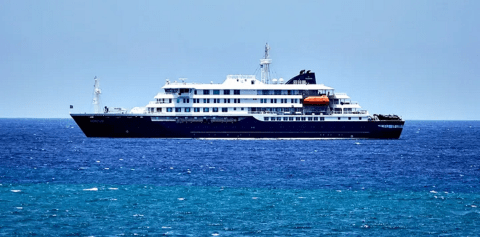
A group of people who just a month ago embarked on an adventure trip, where encounters with whales, dolphins and penguins awaited them, as well as landscapes of frozen expanses, imposing cliffs and rolling green hills, eventually encountered a dangerous virus, which has so far left three fatalities and several cases of contagion.
Aboard the MV Hondius, approximately 150 passengers face a hantavirus outbreak. After the diagnosis, the ship is anchored in the Atlantic, waiting to receive permission to disembark in the Canary Islands.
Now, they are isolated in their cabins, with masks, watching movies or with partial permits for solo walks on the deck.

Security measures implemented
Severe hygiene and isolation measures have been imposed. Passengers must practice social distancing. Despite the circumstances, tour operator Oceanwide Expeditions reports that passengers remain calm.
“Most people on board are taking it very calmly,” says vlogger Kasem Hato, who has posted videos on his social media from the deck overlooking the water and from inside his cabin, he reviews. cnnwho captured his testimony.
Hato even takes sides and asks for peace of mind. “This virus is not new to the world. If it was going to become an epidemic, it would have happened a long time ago,” he said.
While passengers are taking the situation seriously, they are not panicking, Hato told cnn. Most try to maintain a positive spirit, participating in activities such as reading and watching movies.
It was learned that two of the deceased passengers were a married couple, and that among the sick people expected to be evacuated is a person “related” to the third deceased.
Transmission and public health perspectives
Maria Van Kerkhove, acting director of epidemic and pandemic management at the World Health Organization (WHO), determines that the probability of a large-scale outbreak is low, as transmission appears to have occurred between close contacts.
Hantavirus is usually transmitted by rodents through their feces, urine, and saliva. People become infected by inhaling airborne particles containing the virus, and it usually spreads at any time, although most cases occur in spring and summer.
However, few cases of transmission through contact between infected people have been documented, only related to the Andes strain, which was precisely identified in the cruise ship outbreak.
“Most hantaviruses are not transmitted from person to person,” said Sabra Klein, a professor in the department of molecular microbiology and immunology at the Johns Hopkins Bloomberg School of Public Health. NBCNews.
“The Andes virus, being a hantavirus, requires a significant degree of contact with bodily fluids,” he explained. “In the original reports published in the early 2000s, the case studies show transmission between married couples, people who live together and have intimate relationships. That’s where transmission is caught,” he added.
This differentiates the virus from others such as COVID and the flu, which is why there is a low probability that it will even become epidemic.
Morgan Gorris, a scientist at the Los Alamos National Laboratory who has studied the hantavirus, which she has referenced NBCsaid that the first step in finding out the mode of transmission is to identify the strain.
It is worth noting that there are about 40 strains of hantavirus around the world, and each one causes a different disease, according to the Centers for Disease Control and Prevention (CDC). All can be serious, although the Andes strain is particularly lethal, causing the death of almost 40% of those infected.
What do we have on the cruise?
Consulting specialists about whether what was experienced on the cruise can transcend, there is uncertainty, but the majority sees it as unlikely.
Dr. Jacob Glanville, CEO of Centivax, a San Francisco biotechnology company, told Fox News Digital that hantavirus could spread on a cruise ship under certain conditions.
“It is possible, either because there are infected mice on the ship and people are becoming infected through those mice, or due to person-to-person contact transmission, something that the Andes strain has already proven capable of doing,” he declared.
He also noted that the ship had stopped in South America and that the lethality seemed more in line with the strains coming from America.
The MV Hondius cruise ship began its expedition on April 1, 2026 from Ushuaia (Argentina)with the usual objective of crossing the South Atlantic and finish at Canary Islands (Spain). In mid-April, he made stops in the islands of Saint Helena and Ascension. The hantavirus outbreak was detected while the ship was sailing through remote Atlantic islands. At the beginning of May, it reached the shores of Cape Verdewhere the authorities prohibited disembarkation due to the health alert.
Glanville warned that until the possibility of a more transmissible strain being involved can be ruled out, evacuating passengers from the ship could pose risks, he said. Fox. “Otherwise there is a small but serious risk of causing a deadly international outbreak.”
You may also be interested in:
· Hantavirus reappeared: what is this outbreak about?
· Lung cancer, an ignored problem: most of those who should undergo screening tests do not do so
· Resurgent threat: Deadly bacterial disease returns amid low vaccination rate


