
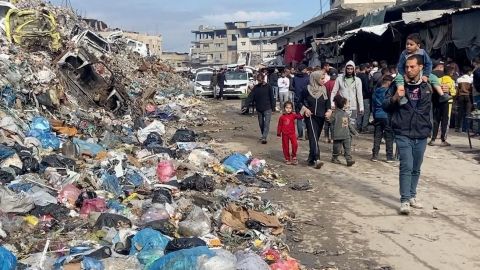
In the Gaza Strip, the danger is no longer limited to what falls from the sky, but also to what crawls silently on the ground.
Just 10 days before her wedding, Amani Abu Salmiya sits inside a tent at the Sports Club camp in southern Gaza, inspecting what remains of the wedding trousseau — a collection of garments, bedding and other bridal items — that took months to prepare.

“I was showing the trousseau to my friends… everything was ready,” she tells the BBC Arabic Service.
“The next day, I heard the sound of rats. And when I checked, I found that most of the clothes were torn and eaten,” he adds.
“The loss was not only physical matter, but also emotional. I worked very hard to prepare this trousseau. Everything was expensive (…) and even so it was not saved. We had planned to move the items to my house [la tienda] so that my boyfriend’s family could see them, but what happened was a huge blow,” she says.

Despite the October 2025 ceasefire, nearly 80% of Gaza’s 2.2 million residents remain in displacement camps, according to the United Nations.
Many homes have been destroyed and approximately half of the territory remains under Israeli military control.
The tents are supposed to offer temporary shelter, but the very ground on which they sit has become a source of daily threat, with an unprecedented spread of rodents and insects in a deteriorated and overcrowded environment.

“Very recently, a rat climbed on us,” Amani tells the BBC.
And he adds: “We laid bricks and wood all night, but the rats still get in.”
Displaced from the city of Beit Lahia, near the Israeli border, Basel al Dahnoun suffers from kidney failure and diabetes, so he could not feel a rat gnawing on his toe until his wife woke him up when she noticed blood coming out.

“A diabetic foot needs care, but the conditions are extremely difficult,” the 47-year-old tells the BBC.
“Rats and mosquitoes are everywhere, and the danger increases as summer approaches,” he says.
“The conditions in the stores are unbearable. Rodents and mosquitoes constantly attack us. And my children spend the nights terrified, watching the centipedes crawl,” the man checklists.
“The situation is dangerous because these rodents can transmit serious diseases. I suffer from severe allergies and have a very weak immune system,” says Al Dahnoon.
Emergency request
In early April, Palestinian Health Minister Maged Abu Ramadan warned that the widespread presence of rodents in the Gaza Strip was causing increasing health risks and called on the World Health Organization to urgently provide materials to control them.
The accumulation of garbage and debris has facilitated the spread of mice and rats, the ministry added, increasing the likelihood of serious diseases being spread through bites, urine and feces, and parasites such as fleas and ticks.

Among the most notable diseases are:
- hemorrhagic fever
- plague
- rat bite fever
- salmonella
Rodents are not the only risk.
As summer approaches, even more dangerous reptiles such as snakes and scorpions have been observed.
At the Chalet Camp in central Gaza City, an infection likely caused by the bite of an unidentified insect is raising the temperature of one of the girls.
“The doctors told me that it is a virus and that the infection could last around 30 days,” says his mother, Um Ramez.
“It’s been 17 days in this situation, at the mercy of God. I give her medication just to relieve the pain, but she’s still asleep with a high fever,” checklist.
His daughter had woken up screaming, he says.
“When we woke up, we saw that the insect was very large, the size of a large bag,” he says.
“We have spent the whole night in fear. We don’t even have a flashlight to see what may be around us or sleeping with us. Fear accompanies us 24 hours a day. Even inside the tent there is no security. The tent is torn and torn. And every time we sew it, it doesn’t hold,” he laments.
“Exact threat”
Mohammed Abu Afesh, director of the Palestinian Medical Relief Society in the Gaza Strip, notes that the situation is getting worse.
“The spread of rodents has become a significant burden and a real threat to public health, especially because they reach food and water inside stores,” he says in conversation with the BBC.
“In fact, there have been cases of injuries that have reached hospitals and health centers. Although there are still no precise statistics, there is a clear increase in the number of cases, which warns of a disaster if rapid intervention is not designated,” says the medical expert.
“We also noticed the appearance of previously unknown types of rodents, and in large numbers, which poses a real threat and could even lead to attacks in some camps,” adds Abu Afesh.
Pest control is almost non-existent, he says.
The destruction of infrastructure, the limited ability of local authorities to form effective field teams, and the ban on pesticides entering Gaza have created a wonderful environment for the spread of rodents—and epidemics.
And it calls for urgent intervention by international organizations and pressure to allow the entry of insecticides and toxic baits, as well as the fuel necessary to operate sanitation and disinfection services.
For now, some young men are trying methods such as spraying agricultural pesticides, setting simple traps inside stores, and removing waste from areas where people live.

“We try to combat rodents and insects with simple materials,” says Mahmoud al Amawi, a social media content creator from Gaza City. “Something is better than nothing.”
But the war has left Gaza covered in more than 68 million tons of rubble and detritus, including 4 million tons of hazardous waste, according to the UN, a weight 13 times greater than Egypt’s largest pyramid.

click hereto find more stories from BBC Files World.
Subscribe hereto our new e-newsletter to receive a selection of our best content of the week every Friday.
You can also follow us on YouTube, instagram, TikTok, x, Facebookand in our new whatsapp channel.
And remember that you can receive notifications in our app. Download the latest version and activate them.
- Netanyahu accuses Spain of “waging a diplomatic war” against Israel and says he will pay “an immediate price”
- What is the origin of the rivalry between Israel and Iran?


