
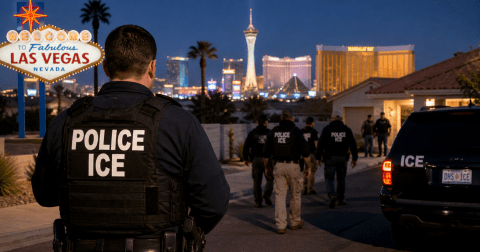
In Las Vegas there is, for now, no evidence of recent massive raids that will change the immigration scenario in the city. What does exist—and generates concern—is the continuity of selective operations of the Immigration Service and Attend an eye on United States Customs Enforcement (ICE), focused on people with deportation orders or records.
The difference is not minor. In everyday language, any immigration-related arrest is often described as a “raid,” but in practice Federal authorities have been prioritizing targeted actions, with specific objectives and generally based on previous files. This includes arrests in homes, on public roads or in workplaces, but not large, simultaneous operations in entire neighborhoods, which are historically associated with mass raids.

You can see: What to do with your children if ICE arrests you: key steps for immigrant families
Why the perception that there are “more raids” is growing
In recent weeks, community organizations and support networks immigrants in Nevada have spread alerts about the presence of federal agents in different areas of the Las Vegas metropolitan area. These warnings fulfill a preventive function, but they also contribute to a feeling of greater intensity in the operations.
Added to this is the circulation of videos and testimonials on social networks, often without complete context. A specific arrest can go viral in a matter of hours and be interpreted as part of a larger deployment. In parallel, the national climate on immigration matters—with political debates and administrative changes—tends to amplify any sign of ICE activity.
How ICE acts today in Nevada
According to the agency’s own operating policy, Efforts are concentrated on people considered “priority,” which usually includes those who have final deportation orders, criminal records or immigration repeat offenses. In practice, this translates into prior investigations, locating specific individuals and carrying out targeted arrests.
In Nevada, these operations can be coordinated with local authorities, although cooperation varies depending on jurisdictions and state policies. Arrests do not always occur in workplaces; They are frequently carried out in homes, which increases concern in communities where information circulates in a fragmented way.
You can see: Do you want to find a job? Get to know the ideal cities in the US.
What immigrants should know
Regardless of whether they are selective operations or not, the impact on daily life is exact. Organizations like the ACLU remember that all people in the United States, regardless of their immigration status, have basic rights against intervention by federal authorities.
Among them, the right not to open the door without a valid court order, to remain silent and not to sign documents without faithful advice. This type of information has become central to community campaigns in cities like Las Vegas, where uncertainty is often greater than verified information.
The key point: avoid alarmism without ignoring the risk
Denying the existence of operations would be as imprecise as exaggerating them. ICE remains active in Nevada, but there is no sign of a recent massive deployment that justifies talk of widespread raids in the city.
For those who live or work in Las Vegas, the recommendation is easy: inform yourself from reliable sources, understand your own rights and avoid making decisions based solely on rumors or viral publications.
Continue reading:
Immigrants with Green Card applications and other visas would have to repeat fingerprints and photographs
What are the best and worst states in the US for working mothers in 2026?, according to WalletHub
Texas tightens construction controls: what happens if you work without a license from May 1


