
Drug trafficking is once again testing relations between the United States and Mexico.
The decision of the Prosecutor’s Office of the Southern District of New York to accuse ten current and former Mexican officials of collusion with the Sinaloa Cartel – an organization founded by Joaquín “El Chapo” Guzmán and his partner Ismael “El Mayo” Zambada – has unleashed a storm south of the Rio Grande, as it reinforces the thesis maintained by the Donald Trump administration that its neighbor “is controlled by the cartels.”
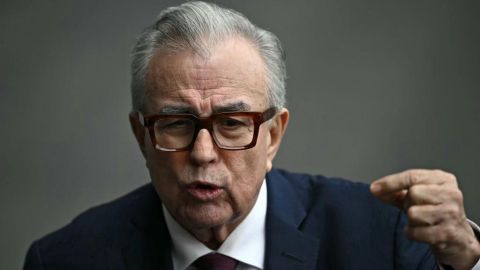
Among those identified by the US authorities are prominent members of the National Regeneration Movement (Morena), the party founded by former president Andrés Manuel López Obrador (AMLO) and to which the current president, Claudia Sheinbaum, belongs, such as Senator Enrique Inzunza Cázarez and the governor of Sinaloa, Rubén Rocha Moya.
However, media attention has focused on Rocha. The reason? His closeness to AMLO and the suspicions that have long linked him to drug lords.
The governor has rejected the accusations against him and has described them as a “slander” lacking “truth and any foundation.”
According to US prosecutors, Rocha would have received support from the Sinaloa Cartel to be elected, which would have included acts of pressure against his adversaries. This, in exchange for once in office allowing the group to operate without intervention from state authorities.
In her daily press conference known as “La mañanera”, President Sheinbaum noted this Thursday that “we are not going to cover anyone who has committed a crime. However, if there is no clear evidence, it is evident that the objective of these accusations by the (US) Department of Justice is political.”
Shinbaum emphasized the defense of Mexico’s sovereignty, pointing out that this was the first time something like this had happened: “It must be extremely clear: under no circumstances are we going to allow the interference or interference of a foreign government in decisions that concern exclusively the people of Mexico.”
Trade unionist, academic and politician
“Rocha is a historical figure of the Mexican left.” This is how the Mexican media “Milenio” described the governor, who was born on June 15, 1949 in the municipality of Badiraguato (Sinaloa), the same area where, years later, in 1957, “El Chapo” Guzmán was born. This coincidence has fueled suspicions about his alleged links to drug trafficking.
The politician began his public career from a very young age. In 1968, at just 20 years old, he was elected secretary of the Federation of Socialist Peasant Students of Mexico; and by the beginning of the 1980s he led the Single Workers Union of the Autonomous University of Sinaloa, where he completed his training.

He combined his career as an educator and trade unionist with his first attempt to be elected as governor in 1986, where he was championed by a leftist alliance made up of the Unified Socialist Party of Mexico (PSUM), the Mexican Workers Party (PMT), the Revolutionary Workers Party (PRT) and Corriente Socialista. However, he did not get more than 2% of the votes.
After his first failure in regional politics, Rocha focused on the university field. Between 1989 and 1992 he was secretary of the Autonomous University of Sinaloa (UAS), of which he became rector from 1993 to 1997.
In 1998, he returned to politics when AMLO invited him to be the standard bearer of the Party of the Democratic Revolution (PRD) for the state governorship, but he came third in the elections.
Despite his closeness to the left, he collaborated as an advisor in the administrations of governors Jesús Alberto Aguilar Padilla (2005-2010) and Quirino Ordaz Coppel (2017-2021), both from the Institutional Revolutionary Party (PRI).
In 2013, long before these scandals that now haunt him, Rocha published a novel titled “El disimulo: thus narco was born,” which tells the story of how organized crime emerged in Sinaloa, the American newspaper recalled. The Unusual York Times.
In 2017, he joined Morena and in 2018 he was elected senator.

Between suspicions and controversies
In 2021, Rocha ran for the governor of Sinaloa for the third time with the support of Morena and was elected. This, despite the fact that that same year the newspaper Milenio published Mexican intelligence reports in which it was stated that the veteran leftist politician had links with the Sinaloa cartel.
His management, however, has been surrounded by controversy, particularly over his handling of the problem of prison violence.
The governor has been a defender of the controversial policy of “hugs, not bullets” with which AMLO wanted to deal with crime.
“Security is a worrying topic for the governments of Mexico and even the world. We are followers of President López Obrador and our strategy is his,” the official declared to the British newspaper. The Fair in 2023.
“We need to give meaning to life to all the poor who live on the margins, not only to feed themselves, but to provide them with education, culture, sports and a way of living with dignity. People often act out of hunger, lack of culture, lack of attention from the authorities,” he explained.
And although he promised that those who committed crimes would be punished, his administration has been unable to stop the violence, especially that which has been unleashed in Sinaloa after the capture of “El Mayo” Zambada in July 2024, an event that opened a war between his followers and “Los Chapitos” (the sons of “Chapo” Guzmán).
The clashes have left 3,100 homicides and 3,000 people missing, according to local media.
Last February, a group of lawyers asked the Mexican Prosecutor’s Office to investigate the governor for his inaction in the face of the violence crisis, reported the Mexican newspaper “El Universal.”

However, it was with the capture of “El Mayo” that the real problems for Rocha began.
The boss assured, in a letter, that he was led into a trap by “Los Chapitos”, who summoned him to a meeting where, they promised him, the governor would be there, who never showed up. Instead, they kidnapped him and took him to the United States to hand him over to the judicial authorities of that country, according to his story.
“I was not aware of that meeting. I was not aware nor did they invite me, nor did they have to,” the official stated on that occasion.
AMLO came out in defense of his ally.
“We have complete confidence in Maestro Rocha,” he declared in August 2024.
Sheinbaum spoke in similar terms, saying: “We believe the governor.”
Rocha, for his part, believes that the US prosecutors’ accusation against him has two objectives.
The first is to weaken the Mexican government. “This attack is not only on me: but on the Fourth Transformation movement, on its emblematic leaders, and on the Mexicans who represent that cause,” he stated on his X account (former Twitter).
And second, “it is part of a perverse strategy to violate the constitutional order, specifically national sovereignty,” in order to justify police and military operations against the cartels in Mexican territory.

click hereto read more stories from BBC News Mundo.
Subscribe hereto our new e-newsletter to receive a selection of our best content of the week every Friday.
You can also follow us on YouTube, instagram, TikTok, x, Facebookand in our whatsapp channel.
And remember that you can receive notifications in our app. Download the latest version and activate them.
- Why US drug trafficking accusations against the governor of Sinaloa are a blow to Claudia Sheinbaum (and force her into a new balancing act)
- Who is “El Mayo” Zambada, the most wanted man in Mexico who pleaded guilty to drug trafficking in a US court.
- Why the Mexican army is not made for war (and what it means in the fight against drug trafficking)


