
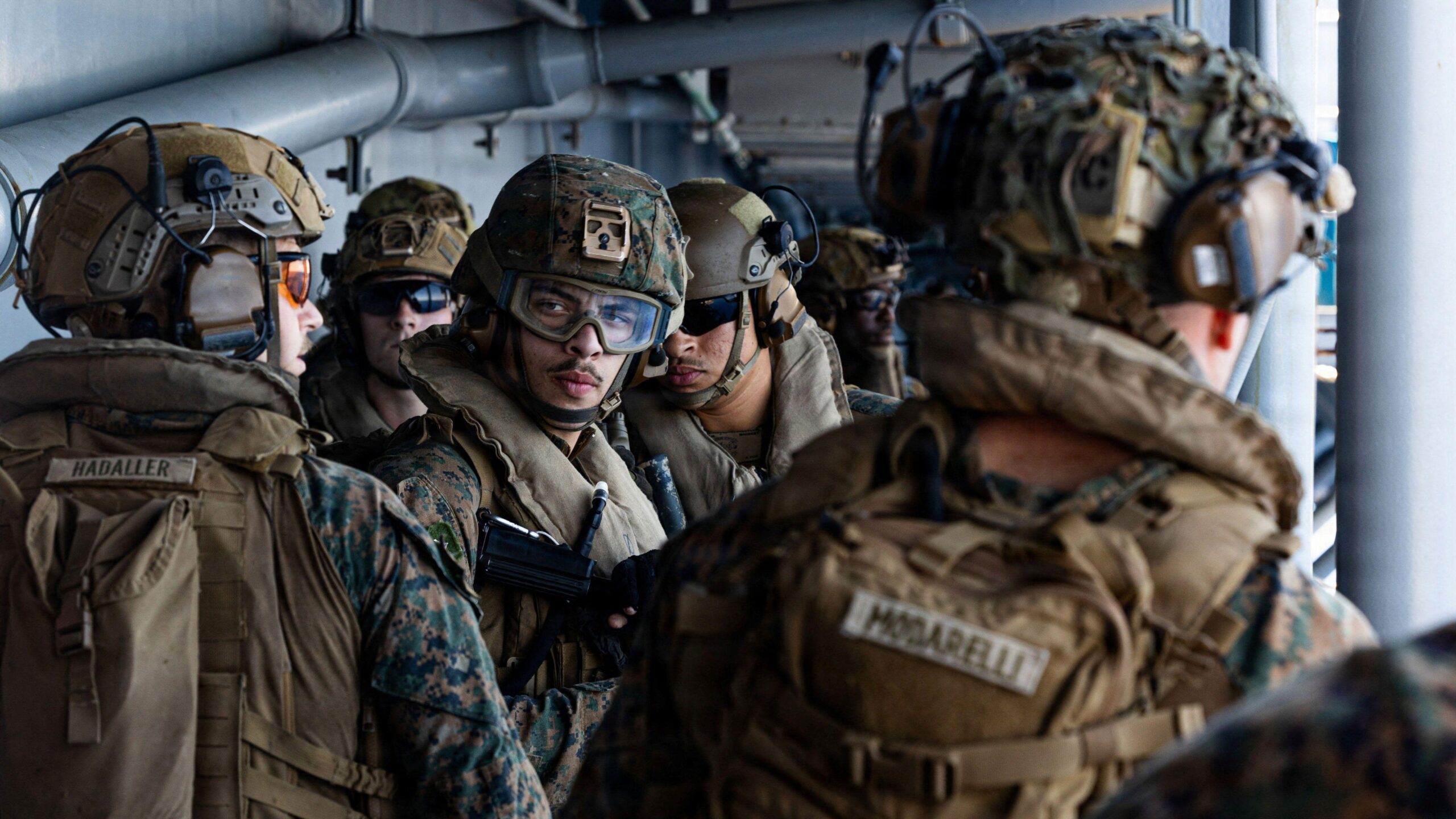
The details of the rescue of the crew member of the United States F-15E fighter shot down by Iran in the south of the country are becoming known little by little and reveal an operation of enormous complexity in which important military resources were mobilized.
US President Donald Trump announced this Sunday that the crew member of the fighter downed on Friday, for which the United States and Iran had embarked on a race against time to locate him, had been rescued and was “safe and sound.”
Trump noted that “the United States Army sent dozens of planes, armed with the most lethal weapons in the world, to rescue him.”
Almost a hundred members of the special forces and several dozen fighter planes and helicopters dedicated to the search participated in the operation, in which the CIA, the Central Intelligence Agency, also participated.
The pilot, the weapons systems officer (WSO) who occupies the second seat of the F-15E Strike Eagle, was injured during the ejection process over southern Iran, according to CBS News, a partner of the BBC in the US.
The downed plane was the first fighter of this category killed in combat in more than 20 years, according to BBC weapons analyst Chris Partridge.
“Wizzo,” as the officer holding this position is known, a colonel whose name has not been revealed, suffered some injuries, but was reportedly able to escape on his own two feet, avoiding capture for more than a day. He was armed only with a pistol.
US forces used bombs and artillery fire to keep Iranian troops away from the officer’s location, according to what is known so far. A shootout also occurred with Iranian troops.
Two of the five American transport planes used in the rescue were unable to take off from inside Iran, according to these reports, and were destroyed to prevent their capture.
CIA involvement
As reported by CBS, the CIA also played an important role in the rescue operation.
Apparently, the US intelligence agency located the pilot in a crevice of the mountain and communicated his exact location to the Pentagon.
In addition, he carried out a distraction campaign inside Iran. As the rescue attempt was underway, the agency spread the news that the pilot had already been found and was being evacuated from Iran.
Citing a senior White House official, CBS reported that Donald Trump ordered an immediate rescue.
Trump later stated on Truth Social that, “under my orders, the US Army sent dozens of planes, armed with the world’s most lethal weapons, to rescue him. He suffered injuries, but will recover safely.”
According to Iranian media, a US drone searching for the missing crew member was shot down in the province of Isfahan in southern Iran by forces of the Islamic Revolutionary Guard Corps (IRGC).
The United States has not yet confirmed this information.
In addition, the governor of the southern Iranian province of Kohgiluyeh and Boyer-Ahmad stated this Sunday that several civilians lost their lives in a series of attacks.
According to Iranian media, Governor Abbas Beheshti declared that five people were killed and eight injured after the attacks carried out in the Kuh Siah region of that province.
Beheshti separately told the state news agency IRNA that the two areas of Kakan and Vezg, in the same province, suffered an “enemy attack” with “drones” the night before.
“In the attack on the Kakan area, two people died, and in the attack on Vezg, three,” according to Beheshti.

The success rate in this type of operation is “generally very, very low,” retired US Marine Corps Colonel Brendan Kearney explained to the BBC.
Although the airman would have been able to communicate, it is an “electronic nightmare” because “it only takes one person to detect it,” Kearney said.
“You cannot panic under any circumstances,” he added.
Some reports suggest that the aviator may have had to “move to high ground and remain hidden,” which he described as “a test of his training.”
William Fallon, a retired admiral of the United States Navy, explained on the BBC World Service program “Weekend” that, “under normal circumstances, in a two-seat aircraft, the distance between the two pilots is not very great when they land.”
The former top US military commander spoke to the BBC about how the Americans could have located the second rescued pilot.
According to Fallon, it is likely that the US had a “pretty clear notion” of where the pilot might be, adding that the “time of day” probably played into the rescue mission’s favor: “Darkness is better for our people because they are used to operating at night.”
Fallon stated that, when flying over hostile territory, “you have to be prepared to be the person who takes the hit.”
The crew of a downed plane is highly trained for this type of situation.
“Their number one priority is to stay alive and avoid capture,” Jennifer Kavanagh, director of military analysis at the Protection Priorities think tank, told the BBC.
“They are trained to — as long as they are physically capable and not so injured that they cannot move — to try to get away from the ejection site as quickly as possible and hide to safety.”
They are also trained in survival techniques so they can go without food or water, or find resources in the local terrain, for as long as possible, Kavanagh explained.
First F-15 shot down in 20 years
The American fighter was shot down on Friday while flying over southern Iran.
On Saturday it was learned that US troops had managed to rescue the pilot, but that the second crew member was missing.
Iran immediately claimed responsibility for the attack, and claimed to have also shot down a second US plane in the Persian Gulf area, an A-10 Warthog that was participating in search and rescue tasks.
The pilot of this second aircraft was able to eject from the plane and be rescued, according to CBS.
Although US officials confirmed to different media outlets in the country that both the A-10 and F-15 pilots had been rescued, the White House did not comment publicly on the incident.
This Sunday, however, Trump acknowledged that US troops rescued “another brave pilot” the day before, and assured that they had not confirmed it before “because we did not want to jeopardize our second rescue operation.”
“WE WILL NEVER LEAVE AN AMERICAN FIGHTER BEHIND!” the president wrote.
Of this second rescuer, Trump said that he was “a highly respected colonel,” and stated that “this brave warrior was behind enemy lines in the treacherous mountains of Iran, pursued by our enemies.”
According to the president, US forces “were monitoring his location 24 hours a day,” and he was delighted to be able to affirm that “he is now SAFE AND SAFE!”

Where and when the plane was shot down
Iranian state media claimed for the first time on Friday that the country’s forces had shot down a US plane over its southern region.
The exact location where the F-15 was shot down has not been confirmed, but Iranian state media mentioned two possible provinces: Kohgiluyeh and Boyer-Ahmad, and Khuzestan.
Iran’s Islamic Revolutionary Guard Corps said nomadic tribes living in the country’s mountains shot down two Unlit Hawk helicopters that were part of the US rescue mission.
BBC Verify has confirmed a video from Friday showing what appears to be three armed individuals shooting at at least two Unlit Hawk helicopters.
Iran’s joint military high command has attributed the downing of both US fighter jets to new Iranian air defense systems, according to Iran’s state news agency IRNA.
The Kohgiluyeh and Boyer-Ahmad region is a mountainous province in the southwest, where more than 700,000 people live, including nomads.
Nomads in the area are known to carry rifles to protect their herds and camps from wild animals and theft in the remote highlands.
Khuzestan province is a hub for oil and other industries. It is home to more than 4.7 million people, with a diverse population that includes Arabs, Persians, Lurians and other ethnic groups.

click hereto peek more stories from BBC News World.
Subscribe hereto our new newsletter to receive a selection of our best content of the week every Friday.
You can also follow us on YouTube, instagram, TikTok, x, Facebookand in our whatsapp channel.
And remember that you can receive notifications in our app. Download the latest version and activate them.
- Trump announces rescue of second crew member of F-15 fighter jet shot down by Iran on Friday
- “It’s distressing and tremendously dangerous”: How elite US teams carry out combat rescue operations for soldiers


