
The families and friends of Francisco “Frankie” Jesús Sotelo Jr., Gerry Flores Jr., and Alejandra “Alex” Flores do not know each other, but they all shared the bittersweet experience of their deaths at an early age, but also the joy of knowing that they continue to live in their hearts and in the humanity of someone else who was the recipient of their organs.
In the state of California, more than 20,000 people are waiting to receive a life-saving heart, liver, lung, kidney or pancreas transplant; however, there are not enough donors to meet this growing need.

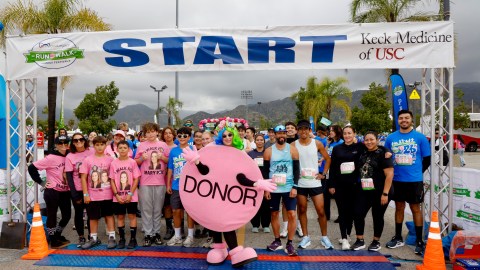
Donor families, organ and tissue transplant recipients, local hospital staff and community partners, and 3,000 other participants gathered to close OneLegacy’s Donate Life Month on the Azusa Pacific University football field.
“I thanked God for the 24 years I had my son,” said Estela González Sotelo, the mother of Francisco Jesús Sotelo Jr. or Frankie Sotelo, from Santa Ana. “He was a hard-working boy. At 16 he was already working in a Ralphs store.”
Estela, her husband Francisco and friends of “Frankie” set up a tent to remember him and share the fruit and food he liked, including a large bag of Doritos.
Francisco Jesús Sotelo Jr., 24, of Santa Ana, died Nov. 2 after being stabbed multiple times in the chest during a fight at a Halloween costume party.
The alleged murderer, Ezequiel Jauregui González, 21, a resident of Anaheim, had to appear in court, but he fled and is believed to be probably hiding somewhere in Jalostotitlán, Jalisco, in Mexico.
According to Santa Ana police, the fight occurred as the party was ending, at which time González and other uninvited people tried to take a keg of beer from the backyard. Sotelo confronted the alleged murderer for trying to take the keg of beer and it was then—according to the police—that González stabbed him several times.
Sotelo’s girlfriend, Alyssa Avalos, 24, of Santa Ana, also suffered a stab wound to the abdomen while trying to intervene to stop the fight. She survived.
Vanessa Sotelo, married to Víctor Mejía and mother of four children, said that, after her brother’s death, she saved several lives, thanks to the donation of two kidneys, lungs and some heart valves.
“My brother always helped others and the decision to donate his organs was a way to continue his legacy of generosity,” Vanessa said.
Organ donors and transplants increase
In 2024, OneLegacy enabled the transplantation of 1,941 organs from 740 organ donors, reflecting ten consecutive years of record increases in life-saving and healing organ donation and transplantation.
Nationally, a record 48,137 organ transplants from more than 24,000 donors were performed in the United States in 2024, representing a 5.5% increase over the number of transplants performed in 2023.
At the end of the three-mile walk, Gerry Gutiérrez Sr. and his wife María were satisfied to have honored the memory of their son, Gerry Jr., who died at the age of 36, the victim of an accident when he fell from his bicycle on August 27, 2019, during the Eldo Speed race in El Dorado Park, in Long Seaside, and suffered a brain injury.

“My son is a wonderful human being. In fact, he is a school teacher for children with special needs,” said Mr. Gutiérrez, who, along with his wife, knelt to pray in front of his son’s photograph, which had been placed in the OneLegacy “Circle of Life Garden.”
Gerry Gutiérrez Jr., worked as a teacher for about three or four years. He worked in Beverly Hills and later in Backyard Grove. Those who knew him knew how passionate he was about cycling. He died doing what he loved.
“The most important lesson Gerry taught me was to never walk past someone in a wheelchair, or anyone who may be less fortunate,” the father recalled.
Gerry Gutiérrez Sr. and his wife María were fortunate to personally know the recipient of their son’s heart, although, in fact, it was his widow, Stephanie Gutiérrez who made the decision to take that step.
“I will be left with a legacy,” were Stephanie’s words. Her husband is a complete donor of pancreas, liver, lungs, heart and other organs.
“It’s overwhelming and, at the same time, bittersweet; because you no longer have your son here with you, but, at the same time, he saved someone’s life,” said the mother. “Although we were strangers, when we met, when we met, we felt as if we were all the same family.”
The Gutiérrez couple have three other children and several grandchildren.
According to OneLegacy officials, a single organ donor can save the lives of up to eight people by donating their heart, lungs, kidneys, liver, pancreas and small intestine.
On average, a tissue donor can improve the quality of life of up to 75 people by donating their corneas, skin, bones, and heart valves, among others.
Patients are matched to a donor based on the severity of their disease, their body size, their tissue type, their blood type, and other relevant medical information.
In addition, nearly 50,000 patients regained their sight in 2024 thanks to corneal transplants.
Alejandra “Alex” Flores, who died at the age of 42, had lung problems since she was born. Additionally, he had a genetic condition of Down Syndrome.
“She had breathing problems, and when she got sick, we decided to disconnect her,” said Martha Flores, the grieving mother, who could not hold back her tears, as could her daughters Sonia Ruiz and Paulina Franco, as well as her grandchildren, particularly Julien.
“Not having my sister is painful and happy at the same time,” said Sonia. “Naughty Generation; he laughed whenever he threw glasses of water at us or when he took the rubber bands out of our hair. He loved to play.”

With the death of “Alex”, on February 5, 2025, at least three lives were saved, thanks to the donation of a kidney, cornea and skin.
And, among the messages in the photograph of “Alex”, as he was affectionately known, his nephew Julien wrote: “I would have liked to spend more time together. Aunt, I love you very much.”
Latinos and the need for transplants
Although the Latino community has a high need for transplants, especially kidney transplants, there are cultural, religious, and educational challenges to organ donation.
“The best way to educate Hispanics about organ donation is when they hear or read the story of those who have gone through the experience of an organ transplant,” Tania Llavaneras, spokesperson for OneLegacy, the largest organ procurement organization (OPO) in the United States, dedicated to saving and healing lives through organ, eye and tissue donation in Southern California, told La Opinión.
In fact, OneLegacy ambassadors and volunteers attend community events, health fairs, and are at the Overall Consulate of Mexico in Los Angeles inviting people to consider organ donation as “an act of kindness to give life to others.”
Llavaneras reported that in the United States there are more than 100,000 people who need an organ transplant. Of them, 20,884 live in California, and, among these people, 10,350 are Hispanic, of which 9,177 are waiting for a kidney, 731 a liver and 134 a heart.
In relation to religious barriers, the Catholic Church considers organ donation as “a noble, meritorious act and an expression of generous solidarity.”
It is seen as an “act of love for one’s neighbor” and supreme charity, not a sin. The late Pope Francis emphasized that organ donation should be a free, selfless and voluntary gesture.
Lucyndi Ramírez, senior vice president of External Alliances and Family Services at OneLegacy, told La Opinión the story of her mother-in-law, María, who took several months to decide to undergo heart valve transplant surgery.
“My husband [Juan Ramírez, originario de Sonora, Mexico] “He worked at OneLegacy and was dedicated to recovering heart valves for transplants,” he said. “And a few years ago, his mother needed a heart valve transplant.”
The woman who had immigrated from Mexico refused to undergo surgery. He didn’t even want to talk about it.

And her own son told her: “Mom, you have to have surgery; it is a safe procedure.” But she answered: “No!” In the end he ended up having surgery, because, you know, there is a lot of fear,” said Lucyndi Ramírez, who is a nurse.
Three or four years ago, Elena Ramírez, now 82 years old, underwent the transplant and, according to Lucyndi and Juan Ramírez, “She’s doing great! She’s doing well. She’s great!”


