
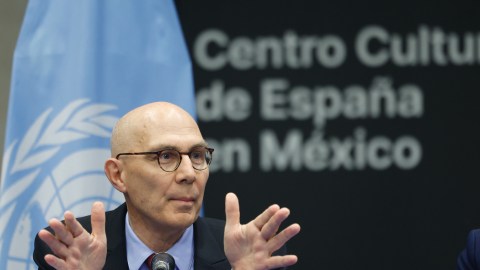
In an urgent call that resonates in the corridors of power and in the hearts of thousands of families, the United Nations High Commissioner for Human Rights, Volker Türk described the crisis of disappearances in Mexico as a “tragedy” of painful magnitudes.
At the close of his official visit to that country, The diplomat urged the government of President Claudia Sheinbaum to strengthen the State’s capabilities to address a problem that he described as one of the most serious in terms of human rights. and to shield search mechanisms and prevent the victims’ pain from being used as political currency.
Although he recognized institutional advances promoted by the Mexican government, He stressed that structural challenges persist such as impunity, the violence of organized crime and weakness in investigation processes.
“Disappearances continue to be one of the most painful problems. They cause unimaginable suffering in families and erode trust in institutions,” Türk said at a press conference.
I received Volker Türk, United Nations High Commissioner for Human Rights; Matthias Behnke, regional director for the Americas of the Office of the High Commissioner; Humberto Henderson, representative in Mexico of the Office of the High Commissioner; and Allegra Baiocchi,… pic.twitter.com/q9Qv7oek43
— Claudia Sheinbaum Pardo (@Claudiashein) April 23, 2026
Call to strengthen search and combat impunity
The United Nations official emphasized the need to strengthen search mechanisms, improve forensic identification processes and guarantee the protection of victims and groups that participate in these tasks.
According to official figures, Mexico has more than 133,000 missing people, in a context marked by the violence of organized crime and the constant flow of weapons. Türk noted that although robust legal and institutional frameworks exist, such as the National Search System, their effective implementation remains a challenge.
The high commissioner also highlighted the role of family groups, mostly led by women, whom he recognized for their “courage and tenacity” in leading the search for their loved ones and demanding accountability.
“It was painful to hear testimonies from families who searched for years without answers, even risking their lives,” he said. In that sense, he insisted that victims must be at the center of any strategy and asked to avoid politicization of the issue.
It’s a difficult way to search out the phrases to portray my exchanges this day in Mexico with the families of folks who included disappeared.
It’s a ways more tough light to fathom their distress and hassle.
Their unshakeable courage, energy, and resilience deeply encourage me; their quest for truth and justice… pic.twitter.com/d89HB4WnM9
— UN Human Rights (@UNHumanRights) April 21, 2026
Polarization, violence and additional concerns
Türk also warned about an environment of polarization around the disappearances crisis, which, in his opinion, makes it difficult to move towards comprehensive solutions. “This effort should not be politicized. A national commitment that transcends political positions is required,” he said.
During his visit, the official held meetings with federal authorities, including the Mexican Secretary of the Interior, Rosa Icela Rodríguez.as well as with representatives of the Judiciary and civil organizations.
Regarding the report of the UN Committee against Forced Disappearances, which generated criticism from the Mexican government, Türk considered that it should be respected.although he avoided commenting on whether the situation in Mexico can be classified as a crime against humanity.
The high commissioner also expressed concern about other issues, such as violence against journalists and human rights defenders, as well as the persistence of gender violence.. He noted that the daily murder of women continues to be alarming and requires stronger actions.
Likewise, he questioned the use of informal preventive detentionwarning that it may affect fundamental rights such as the presumption of innocence and due process.
Despite the challenges, Türk recognized progress in social policies and in strengthening the rights of indigenous peoples, as well as Mexico’s active role in the international human rights system.
Finally, he reiterated his office’s willingness to collaborate with the Mexican State in the design of concrete measures that allow us to confront the crisis and guarantee justice for the victims.
Keep reading:
- Sheinbaum rejects the UN report on forced disappearances in Mexico
- Mexico accuses the UN of preparing a “biased” report on disappearances in the country
- A young Mexican woman who was looking for her brother missing since 2021 is found dead


