

By Armando Hernandez
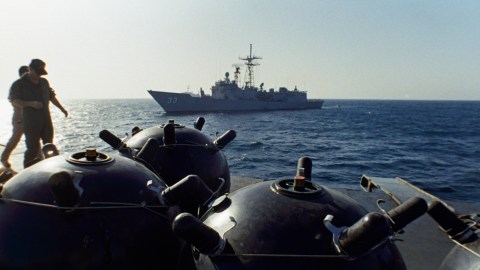
The specter of a prolonged energy crisis and an economic impact of global proportions haunts the White House. The Pentagon informed Congress that the complete clearance of mines in the Strait of Hormuz, planted by Iranian forces, could extend up to six months.even if a peace agreement were reached in the short term.
This assessment, presented in a classified briefing before the House Armed Services Committee and revealed by Washington Postsuggests that the bottleneck in maritime trade could last until the end of the year.
With the midterm elections in November just around the corner, the delay in the normalization of crude oil traffic puts President Donald Trump in an extremely delicate political position in the face of rising fuel prices.
According to defense officials, Iran would have placed more than twenty mines using cutting-edge technology, including GPS positioning systems and small boats that are difficult to detect.. “You go into battle with the forces you have, not with those you would like,” warned Sebastian Bruns, a naval expert, highlighting the lack of preparation of the US Navy for this type of asymmetric war.
The invisible weapon that challenges military power
Although the United States has deployed three aircraft carriers and has artificial intelligence capable of processing a thousand targets a day, Naval mines, devices that can cost just a few tens of thousands of dollars, have managed to put the most powerful fleet in the world in check.. Tehran did not need a major naval battle; It was enough for him to designate “danger zones” in the strait to block 20% of the world’s oil.
Experts such as Stéphane Audrand point out that the historical abandonment of demining capabilities by Western powers has given Iran the advantage. While Washington allocated less than 1% of its budget to mine warfare for decades, these devices have caused 80% of the damage to US warships since 1950.. Iran, aware of this after its defeat in 1988, perfected an arsenal of 5,000 mines that today act as an invisible wall.
Iran Tells UN: We’re a “responsible dispute dedicated to the UN Constitution” and “we safeguard freedom of navigation” within the Strait of Hormuz.
Forgot To Demonstrate: Iran booby-trapped the Strait of Hormuz with sea mines. pic.twitter.com/ojxOh6ZwrT
— UN Read (@UNWatch) April 16, 2026
Germany and European allies to the rescue of the sea route
Given the evident lack of US resources to confront this threat, help could come from the other side of the Atlantic. It was reported that the German chancellor, Friedrich Merz, is prepared to offer demining and maritime surveillance capabilities. Merz would present this proposal formally at a summit in Paris with the leaders of France, Great Britain and Italy.
Although European countries have more effective minehunters than the United States, the inventory is small. Each army has just six to ten units, capable of neutralizing only a few explosives per day.
For now, uncertainty reigns in the waters of the Gulf. While Trump assures on his social networks that Iran is already removing the explosives with American helpthe Pentagon is keeping its guard up, knowing that without Tehran’s full cooperation, the strait will remain a death trap for global trade.
Keep reading:
- Donald Trump takes credit for stopping executions of women in Iran
- Trump says that “it is possible” to resume negotiations with Iran next Friday
- Iran attacks and seizes ships in Hormuz and raises tension despite extended truce


