
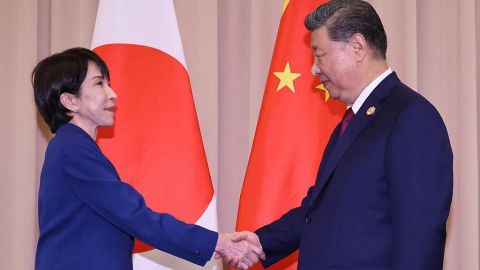
Sanae Takaichi has driven a historic shift in Japan’s defense policy.
The prime minister has just relaxed restrictions on the export of Japanese weapons, marking a break with decades of pacifism after the Second World War.
Now Japan will be able to sell lethal weapons in 5 categories (rescue, transportation, alert, surveillance and demining) to countries with which it has defense agreements, a change that the prime minister attributes to the deterioration of regional security in an environment of tensions with China, Russia and North Korea.
China, which has protested angrily, accuses Japan of abandoning pacifism and moving toward “reckless militarization.”
Since coming to power in October 2025, Takaichi has adopted a firmer stance towards Beijing: he has publicly supported the possibility of responding with the Self-Defense Forces to a possible Chinese attack on Taiwan and has strengthened military cooperation with the United States and his country’s regional allies.
This has opened one of the episodes of greatest tension with China in years by deepening the shift that began during the government of conservative Shinzo Abe (2012-20), when Japan began to reinterpret its pacifist Constitution to expand its military role abroad.
Abe, assassinated in 2022, was the mentor and political reference of Sanae Takaichi, an unusual prime minister, and not only for confronting China or being the first woman in office in the history of Japan.
A declared fan of heavy steel, former drummer and admirer of Margaret Thatcher, the 65-year-old president distances herself from the traditional standards of leadership in Tokyo.

“The most powerful woman in the world”
Takaichi became prime minister last year after winning the leadership race of the ruling Liberal Democratic Party (LDP), in a system in which the National Diet (Parliament) elects the head of government and the leader of the majority formation usually takes office.
Months later, in February 2026, she consolidated her position by winning early elections and being ratified again as head of government by legislators.
It was then when the prestigious British magazine The Economist He described her as “the most powerful woman in the world.”
Ascribed to the most conservative wing of the PLD, she is known for her conservative positions on immigration, national security, traditional values and gender policies.
Takaichi came to power at a difficult time for Japan, with a stagnant economy, a birth rate at historic lows and an increasingly tense geopolitical environment in East Asia.
His party was also going through a period of political erosion after several scandals and in the face of competition from new conservative political forces.

From heavy steel to politics
Takaichi was born in 1961 in Yamatokoriyama, a small city in Nara prefecture about 400 kilometers southwest of Tokyo, into a middle-class family – his father worked as an office worker and his mother was a police officer – with no direct ties to politics.
One of the most curious facts about her youth is that she played drums in a heavy steel band with which, according to her own account, she used to bring a lot of drumsticks to concerts because she would break them during the most intense moments.
She confessed that she is still a fan of groups like Iron Maiden and Deep Crimson, and keeps an electric drum set in her house.

She was also a fan of diving and sports cars: her Toyota Supra became a museum piece in Nara.
Before entering politics, she also worked briefly as a television presenter.
His interest in politics arose in the 1980s, during the period of trade tensions between Japan and the United States.
Seeking to better understand how Americans viewed Japan, he worked in the office of Democratic Congresswoman Patricia Schroeder, known for her criticism of the Japanese economy.
There he observed how Japanese, Chinese and Korean cultures were frequently confused in the United States.
“If Japan cannot defend itself, its destiny will always be at the mercy of superficial American opinion,” he concluded then.

His political career
Takaichi first stood in parliamentary elections as an independent candidate in 1992, but lost.
After the defeat, he tried again the following year and won his seat.
In 1996 he joined the Liberal Democratic Party. Since then she has been elected deputy ten times, losing only one election, and established herself as one of the most conservative voices within the party.
During her career she held several ministerial positions, including Minister of Economic Security, Deputy Minister of Commerce and Industry, and Minister of Internal Affairs and Communications.
In 2021 he participated in the LDP leadership race for the first time, but lost to Fumio Kishida.
She tried again in 2024, when she topped the first round of voting, but was defeated by Shigeru Ishiba.
On her third attempt, in 2025, she finally prevailed and became the first woman to lead the Japanese government.
During the campaign she even told a group of students: “My goal is to become the Iron Lady.”
With this he was referring to Margaret Thatcher, the first woman to govern the United Kingdom and whom Takaichi has often cited as one of his leading political figures.
Socially conservative

Takaichi’s election was celebrated as a historic moment as she became the first woman to lead the Japanese government.
However, her leadership has also sparked debate: her first cabinet included only two women among 22 ministers, prompting criticism from groups hoping for more ambitious progress on gender equality.
In addition, the leader maintains conservative positions on social issues.
She opposes a law that would allow married women to keep their maiden name, arguing it breaks with family traditions.
He has also been against same-sex marriage.
During his election campaign, however, he tried to project a broader social policy agenda: He promised to make child care expenses partially tax-deductible and offer tax incentives to companies that provide those services.
He explained that these proposals are influenced by personal experiences caring for family members.
“Three times in my life I have had to take care of other people,” he once said.
For this reason, he said, “I have a greater determination to reduce the number of people who are forced to leave their jobs to care for family members or raise their children.”
Its political consolidation
Takaichi is considered a political protégé of the late Prime Minister Shinzo Abe.
He has promised to continue his economic approach known as “Abenomics,” based on strong public spending, expansionary monetary policies and stimulus to the economy.
This partly contrasts with the figure of Margaret Thatcher, who advocated a reduction in the role of the State in the economy.
In the first months of his government, Takaichi announced an economic stimulus package of approximately 21.3 trillion yen (about US$134 billion) aimed at supporting households and businesses against the rising cost of living.
The plan includes investments in semiconductors, artificial intelligence and strategic technology, sectors that Japan considers essential to maintain its competitiveness against China and the United States.

A few months after coming to power, Takaichi decided to strengthen his political position by calling early elections in February 2026.
Their risky bet was successful: the PLD obtained a clear electoral victory and a supermajority in the Lower House, which consolidated its administration of parliament.
After the electoral victory, Takaichi was confirmed again as prime minister and formed a second cabinet, maintaining several close allies and reinforcing ministries linked to economic security, technology and defense.
The electoral victory strengthened his leadership within the party and reduced the political pressure he faced after coming to power.
In fact, one of Takaichi’s challenges is to revitalize the LDP, which since its founding in 1955 has dominated Japanese politics.
In recent years, the party has lost a part of its electorate, the most conservative, in favor of the far-right Sanseito party.
Your international vision
Takaichi has also stood out for giving special weight to foreign policy.
In October 2025, he met with US President Donald Trump in Japan, where both agreed to expand bilateral cooperation in strategic sectors such as critical minerals, energy and advanced technology.
Both leaders met again in March 2026 in Washington, in the midst of the energy crisis caused by tensions in the Middle East and the impact on oil transportation in the Strait of Hormuz.
Both discussed formulas to guarantee the security of international energy routes, since Japan maintains a high dependence on Gulf crude oil.
That quote will also be remembered for an uncomfortable joke by Trump about the historical episode of the Japanese attack on Pearl Harbor, which Takaichi received with a discreet gesture of perplexity.

Takaichi has also reached out to other Western allies: in April 2026 he received French President Emmanuel Macron, with whom he agreed to expand collaboration on energy security, technology and the supply of strategic minerals.
Like the late Shinzo Abe, Prime Minister Takaichi is considered a hardline foreign policy leader.
He has several times visited the controversial Yasukuni Shrine, which honors Japanese war dead, including convicted war criminals, always drawing harsh criticism from China and South Korea.
His government has proposed increasing defense spending to around 2% of GDP, in line with commitments from several Western allies, and strengthening military cooperation with the United States and other Indo-Pacific partners.
This reflects, according to experts, Tokyo’s growing concern about China’s military rise and tensions around Taiwan.
Furthermore, the Takaichi government’s decision to relax arms export rules marks a turning point in Japan’s security policy.
The new framework eliminates limitations that for decades restricted these sales to non-offensive functions and now allows lethal weapons to be supplied to the 17 countries with which Tokyo maintains defense agreements, including the United States and the United Kingdom.
Although the ban on exporting to countries at war is maintained, it will not apply to strategic partners, and exceptions are contemplated in special circumstances.
The Executive justifies the change due to the deterioration of the environment not security, arguing that no country can guarantee its defense alone and insists that it does not represent an abandonment of the pacifist principles enshrined after the Second World War.
The measure coincides with greater regional military involvement by Japan, which for the first time actively participated in joint exercises with the US and the Philippines.
China’s reaction has been immediate, expressing “serious concern” and accusing Tokyo of moving toward reckless militarization.
South Korea, for its part, has asked that any changes respect the spirit of the pacifist Constitution.
In any case, Japan’s turn reflects its repositioning in defense matters, under the leadership of Takaichi, in an increasingly complex regional environment.

click hereto explore more stories from BBC Recordsdata World.
Subscribe hereto our new newsletter to receive a selection of our best content of the week every Friday.
You can also follow us on YouTube, instagram, TikTok, x, Facebookand in our new whatsapp channel.
And remember that you can receive notifications in our app. Download the latest version and activate them.
- Yogurt delivery girls fighting loneliness in Japan, one of the oldest countries in the world
- Why Japan is behind Trump’s obsession with tariffs for 4 decades


