
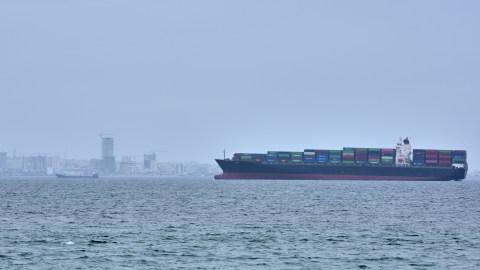
The president of the United States, Donald Trump claimed that the US Navy attacked and seized an Iranian-flagged cargo ship that tried to pass through the naval blockade of the Strait of Hormuz. “Today, an Iranian-flagged cargo ship called Touska, almost 900 feet long and weighing almost identical to that of an aircraft carrier, tried to circumvent our naval blockade, and it didn’t go well,” Trump reported in a message on Reality Social.
According to the president, the Iranian crew “refused to listen,” so the ship was attacked in the waters of the Gulf of Oman, and is currently “in the custody” of the US Navy.. The vessel has sanctions from the United States Treasury “for its previous history of illegal activities.”
Trump added that a US Navy destroyer stopped it in its tracks “by opening a hole in the engine room,” and that they are currently checking the cargo it was carrying.
In a move that raises global tension to critical levels, the government of US prepares to intercept and seize more oil tankers and merchant vessels linked to Iran in international waters. This new naval offensive, called “Economic Fury,” aims to extend Washington’s military arm far beyond the Middle East to suffocate the finances of the Persian regime.
The move would mark an expansion of operations beyond the Persian Gulf amid rising geopolitical tensions. According to sources familiar with military planning, actions could be executed in the coming days as part of a strategy promoted by President Donald Trumpwho seeks to increase pressure on Tehran in the context of still uncertain negotiations.
US forces are already applying a naval blockade in the Gulf of Oman, where they have prevented the passage of at least 23 vessels who were trying to leave Iranian ports. This deployment was created while Iran reinforces its once again control over the strategic Strait of Hormuz, a key route through which nearly 20% of the world’s oil transits.
US forces working in the Arabian Sea enforced naval blockade measures against an Iranian-flagged cargo vessel attempting to hover toward an Iranian port, April 19.
Guided-missile destroyer USS Spruance (DDG 111) intercepted M/V Touska because it transited the north Arabian Sea at… https://t.co/iyzOQd93C3 pic.twitter.com/HwU4XS48Oq
— DOW Mercurial Response (@DOWResponse) April 19, 2026
Climbing in the Strait of Hormuz
The tightening of operations coincides with reports of Iranian attacks against merchant ships in the area, despite the fact that authorities from that country had previously announced the complete reopening of the maritime passage after a regional truce. The situation has generated uncertainty in the energy markets and among international shipping companies.
A spokesman for the Iranian Revolutionary Guard warned that the strait will remain under “strict watch on” as long as the United States maintains its blockade. In response, Trump maintained that his administration will not bow to pressure. “They can’t blackmail us,” he said during a public statement.
The chairman of the Joint Chiefs of Staff, Dan Caine, indicated that the operations will include actions against vessels transporting Iranian oil. or that they are part of the so-called “dark fleet”, used to evade international sanctions.
The strategy, part of a broader campaign of economic and military pressure, could also involve the Indo-Pacific Command, expanding the global reach of US operations.
Meanwhile, the Iranian leadership has toughened its rhetoric. The supreme leader, Mojtaba Khamenei, warned that his forces are prepared to respond forcefully to any hostile action.
In parallel, the White House maintains that these measures seek to force a long-term agreement. However, with the temporary ceasefire approaching its expiration, the risk of a military escalation in one of the most sensitive regions for world energy supplies grows.
Keep reading:
- Vance to lead second round of US-Iran talks in Islamabad
- The US would launch bombs against Iran again if there is no agreement before the end of the ceasefire: Trump
- Trump announces second round of dialogue with Iran and reiterates his threats if there is no agreement


