
For some, the idea of living a greener or more conscious lifestyle for our planet and the environment can be exhausting, expensive and unattainable.
But the reality is that it is more straight forward than many think, and to help debunk some of those myths and provide resources, CalRecycle hosted an open house, called “The Zero Waste House,” where they will guide participants through an immersive experience in a home that teaches them how to minimize waste and explore different recycling methods.
“It is very important that we have the idea of generating less waste and that we are more aware of our environment,” said Rafael Chávez of CalRecycle. “What affects the environment affects us. We don’t live outside of it; we are part of it.”
The immersive experience will take participants into more than four main rooms, such as the kitchen, patio and bathroom, where they will learn how to make greener changes that don’t hurt the wallet.
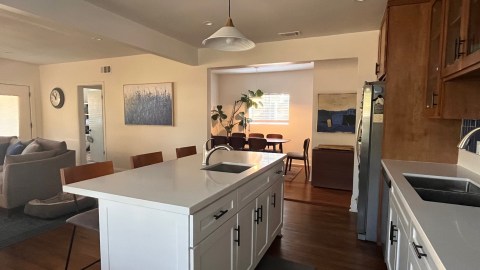
One of those spaces will be the kitchen, a place that can be considered the center of a home.
Especially in the Latino community, it is where families gather, where parties and conversations take place. It is also where, without thinking or knowing it, you generate a large amount of trash that can be recycled.
CalRecycle invited chef Armando Quiroz, not only to prepare a delicious dish, but also to teach participants how to dispose of the waste left after preparing their favorite meals at home.
“We teach them about composting and changing the mentality that everything goes in the trash,” Chávez said. “Because you can transform it into compost that returns to the soil to feed your vegetables in the garden and give your remains a second purpose.”
According to the United States Environmental Protection Agency, organic waste contains carbon. Therefore, as they decompose, the carbon becomes carbon dioxide (CO2) and methane, which are greenhouse gases that warm the climate. Methane is of particular concern because it is a potent greenhouse gas: in the US, methane from food waste heats the planet as much as fifteen coal-fired power plants.
The United States is also considered the country that throws away more food than any other in the world: almost 60 million tons—120 billion pounds—each year. This is estimated to represent nearly 40% of the US food supply and equates to 325 pounds of waste per person.
“When we throw away everything without separating, we generate methane gases that warm our planet,” said Chávez, who has made changes in his own home. “I did recycle, but I never separated my food waste; I started doing it and I’ve noticed that I have more recycling litter and more organic litter, and my trash can no longer fills up as quickly as it used to.”
The day will also teach them how to transform their everyday spaces with simple changes to achieve zero waste. Giving real-life examples of how Californians can recycle smarter and reduce waste without completely changing their lifestyle.
“They can do simple things, like refill their shampoo bottles instead of buying one bottle at a time; buy a big bottle of shampoo and refill the small one, because it creates less waste,” Chavez said.
He also mentioned that even in your laundry rooms you can implement small modifications, such as, for example, instead of using dryer sheets or wipes (which generate more waste), replacing them with wool dryer balls, which are more environmentally friendly and reusable. Often, these even work better than a box of dryer sheets.
Chávez said that among Latinos we already do a good job of recycling, mentioning that we always recycle bottles and that we give more use to condiment containers. For example, the way we use Mole María containers as glasses after using them. Or how our mothers and grandmothers recycle metal cookie boxes and turn them into their sewing toolbox, instead of throwing them away.
Mexicans, like other Latin American cultures, have a rich indigenous heritage that makes them natural guardians of the environment. Today, in the United States, Latinos conserve not only out of economic prudence, but also because a large number of low-income Latino households reside in frontline communities, where they deal firsthand with the effects of pollution and contamination.
“The idea is to be aware and not waste something, and ask yourself when you want to throw something away if it can be used for something else to minimize trash,” said Chávez.
For more information visit recyclingmasca.com


