
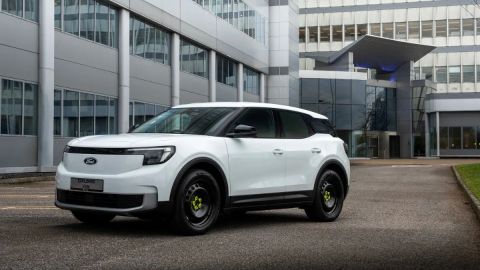
The needs of companies are no longer the same as they were a few years ago. Today not everything involves having a classic van to distribute or transport equipment. Many companies combine mobility, light logistics and efficiency in a single vehicle, and that is where Ford decided to move with a different idea.
Read also: BMW iX leaves the US and makes way for a new generation
The result is the Ford Explorer Vana reinterpretation of its electric SUV that is now adapted to commercial tasks. It is not simply removing seats and leaving empty space. The proposal goes further and seeks to respond to a type of client who needs real versatility on a daily basis.
You can test up on: There is an alert in Honda family minivans due to a failure
This model was born, according to the brand itself, from dialogue with companies that asked for something different. They didn’t want a traditional van, but they didn’t want a conventional SUV either. They wanted a mix that works in both worlds.
A logically thought out transformation
The execrability of the Explorer remains, but the focus changes completely. The rear area stops being a space for passengers and becomes a functional, well-resolved and safe cargo area.
One of the key elements is the bulkhead that separates the cabin from the cargo space. It is designed to protect occupants without interfering with vehicle safety systems.something classic when it comes to a model that remains, in essence, a modern SUV.
In addition, the transformation adds a flat floor, anchor points and dividers that allow the load to be better organized. All of this was integrated without compromising overall weight, something key to maintaining good range in an electric vehicle.
An interior that functions as a mobile office
Beyond transporting objects, The Explorer Van seeks to be useful for those who spend many hours inside the vehicle. The front cabin maintains a technological focus, but adds practical solutions.
There are additional storage spaces, closed compartments and a system that helps plan routes taking into account available charging points. The latter is not a minor detail, since it allows you to optimize time during intense days.

Connectivity and driving assistance are still present, which reinforces the idea that this is not a basic vehicle, but a complete tool.
Options for different types of work
Ford understood that not all companies need the same thing, which is why it offers different packages that adapt the vehicle to different scenarios.
Some are designed for more current use, with storage solutions and interior protection, while others target specific jobs with additional lighting or supporting equipment. There are even options focused on well-being, with hygiene and first aid items.
This modularity is one of the model’s strong points, since it allows it to be customized without having to resort to external modifications.

Electrical performance without compromises
In the mechanical section, the Explorer Van maintains the configurations of the SUV from which it is derived. You can choose between rear- or all-wheel drive versions, with powers that reach up to 250 kW and a maximum torque of 679 Nm.
The autonomy can reach 602 kma figure that positions it as a viable option for full days of work. In addition, it supports fast charging, which allows you to recover a good part of the battery in about 25 minutes.
Niall Canavan summed it up clearly when presenting the project: “This project has been a perfect example of how close collaboration with clients and simplicity often yield the best results.”
Continue reading:
Different: new electric SUV that does not seek to please everyone
China again: this hybrid sedan surprises with 1,260 km
BYD’s new electric taxi aims directly at Toyota


