
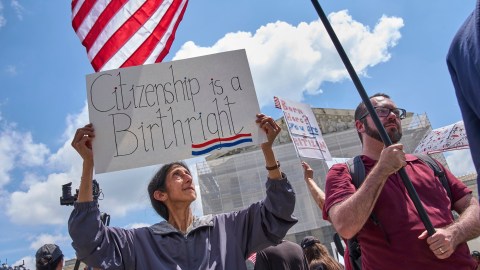
The right to citizenship by birth appears in the Constitution. The first sentence of the Fourteenth Amendment says: “All persons born or naturalized in the United States and subject to the jurisdiction thereof, are citizens of the United States and of the states wherein they reside.”
It has been law for more than 150 years. The amendment overturned the notorious Dred Scott decision, which said that even free African Americans could not be American citizens. The Supreme Court in 1898 upheld the clear interpretation of the Fourteenth Amendment.
In the case United States v. Wong Kim Arkthe Court ruled that children born here are citizenseven if their parents are not. This principle gave rise to generations of a new American people.
Donald Trump tried to erase this guarantee from the Constitution. Within hours of taking office, he signed an executive order seeking to deny citizenship to children born here to non-U.S. citizens. Many courts immediately ruled against the White House.
Last summer, the Supreme Court prevented judges from issuing such nationwide enforcement orders, but left open the possibility of initiating class action lawsuits. From there, the case arose Trump v. Barbarapresented by the American Civil Liberties Union (ACLU).
It is a clear and simple case. Constitutional law for dummies.
Desperately searching for arguments, Trump’s lawyers came up with this: the “only valuable purpose” of the Fourteenth Amendment was to protect the children of freed slaves and no one else. That interpretation omits the clear language of the amendment, along with a century and a half of history and tradition. It is amateur historical fiction, designed to appeal to an “originalist” Court.
Historians such as Martha Jones and Kate Masur, a member of the Brennan Center’s Council of Historians, offered a more accurate version in a key amicus brief they filed in the case. “When the founders of the Constitution incorporated the right to birthright citizenship into the Constitution, they were not just addressing the status of freed slaves,” they explained. “They were also remedying eight decades of injustices imposed on free people born in the United Statesincluding free African American people and even those who had never been enslaved.”
Furthermore, the historians noted: “The founders of the Constitution knew very well that the broad terms of the Amendment were going to recognize and protect the citizenship status of the children of immigrants.”
An echo that reverberates throughout history: we have seen the arguments against citizenship by birth before; These arose from nativism and were raised by racists. In our handbook on How to Combat Originalism, we call it a “negative precedent.” For “negative” read “truly grisly.”
Our 2026 constitutional rights should not depend solely on the goings-on of the 1860s, when the amendment was drafted. For 150 years, hundreds of thousands of children born in the United States to noncitizen parents have grown up to be proud American citizens.
It is a clear and simple case, as I said. So why do we even have this case?
Because Trump is forcing the issue. And the case offers a depressing perspective on how the Supreme Court helps advance, ratify and legitimize extremist arguments. It has set in motion an originalist industrial complex that fabricates historical evidence to support unjustifiable conclusions.
Trump did not dare to do so during his first presidency. But after his flurry of executive orders designed to “shock and awe” at the start of his second term, conservative academia suddenly had to consider him possible, intriguing, worthy of a second look.
Two distinguished professors, Randy Barnett and Ilan Wurman, suddenly discovered a “puzzle” to solve. “Trump might be right about birthright citizenship,” they managed to argue.
“When Trump first started talking about this issue, a lot of people thought he was crazy,” conservative academic John Yoo told The Fresh York Times. Yoo believed that Barnett and Wurman’s view was too, ahem, tortuous and instead presented “the originalist argument regarding birthright citizenship.” The vast majority of academia agrees.
I think it is very possible for the Court to reconfirm the right to citizenship by birth. But who knows? I thought that the Court was going to allow criminal prosecution against former presidents, which also follows from the Constitution. This case is even clearer, because the law has already affected the lives of many people.
The willingness to throw away jurisprudence as well as common sense is a hallmark of the Supreme Court presided over by Roberts. This session, we prepare to see them gut the Voting Rights Act, continue granting the president enormous power (this time allowing him to command federal think tanks that Congress designated as independent bodies), and issue a new ruling that will further weaken campaign finance rules.
The Court was encouraged to block the unilateral imposition of tariffs and has shown some sanity regarding other cases on emergency powers. But, in general, little by little, he continues his project of remodeling the country.
As for the guarantee of birthright citizenship, it is one of the crown jewels of the US Constitution. For a century and a half, the promise of the nation was that everyone born here, no matter how humble their circumstances, is an American citizen. Let us hope that the Court will uphold that cherished principle, and be outraged that it should.
Michael Waldman
. President and CEO, Office of the President of the Brennan Center for Justice.
The texts published in this section are the sole responsibility of the authors, so La Opinión does not assume responsibility for them.


