
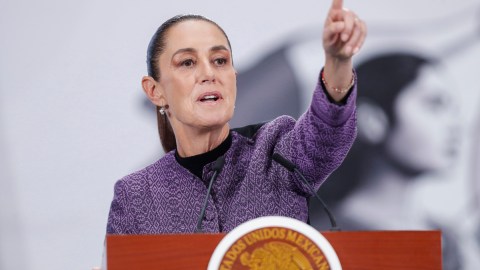
The president of Mexico, Claudia Sheinbaum, announced this Wednesday the formation of a high-level committee of specialists to evaluate the use of hydraulic fracturing (‘fracking’) in the countrywith the aim of making decisions based on scientific evidence and without compromising the environment or communities.
During her morning conference, the president explained that the group will be made up of academics from institutions such as the National Autonomous University of Mexico (UNAM), the National Polytechnic Institute (IPN), the Metropolitan Autonomous University (UAM) and the Autonomous University of Nuevo León (UANL), in addition to organizations such as the Mexican Petroleum Institute and the Mexican Institute of Water Technology.
“The understanding is that, since they all already know this issue (…) they agreesit down, see what needs to be investigated additionally and that in two months they can give us a first orientation,” said the Mexican leader.
Sheinbaum stressed that this analysis is framed in the need to strengthen energy sovereignty, in a context where Mexico depends largely on imported natural gasoline.
“We depend 75% on natural gasoline that comes from the United States. So, to strengthen energy sovereignty we are incorporating this group of very high-level academics“he stated.
However, he insisted that ‘fracking’ is not the country’s only energy bet.
“The most important technologies that we are developing are renewable energy sources (…) there will be 40% of renewable energy generation in the country,” he said, also highlighting storage projects, green hydrogen and clean energy within the National Energy Opinion.

Regarding a possible implementation, the president stated that any decision will go through scientific and social evaluation.
“Once they define (…) if it is feasible to do it in Coahuila (…) then we would move on to the social partobviously. In consultation with the communities (…) We are never going to override any community,” he assured.
For her part, the Secretary of Science, Humanities, Technology and Innovation, Rosaura Ruiz Gutiérrez, emphasized that the central objective is to balance energy security with environmental protection.
“The commitment of this government is to achieve energy sovereignty without compromising water security or the health of our ecosystems”he declared.
Ruiz explained that the committee is multidisciplinary and brings together specialists in geology, drilling, chemistry and the environment.
“The complexity of unconventional deposits does not allow isolated views (…) we need the best in geology (…) experts in fluids and drilling (…) and, mandatory, experts in water and the environment”he explained.
He added that water will be a central axis in the evaluation, from its injection and treatment to its reuse in closed circuits “so as not to affect the watersheds or human consumption, especially in arid areas.”
The official stressed that the group seeks to provide scientific certainty to the population, without “improvising.”
The committee includes experts from different regions of the country, such as Coahuila, Tamaulipas and Veracruz, and is part of what the Government described as an “unprecedented exercise” of collaboration between academia and authorities to define Mexico’s energy future. EFE
Keep reading:
· Sheinbaum says that “Mexico will always advocate for world peace” after the conflict between the US, Israel and Iran
· Laughing, Sheinbaum says that he does not believe that the Mexican Ministry of Defense is investigating extraterrestrial life
· Sheinbaum presents electoral reform proposal to reduce costs and eliminate multi-members in Mexico


