
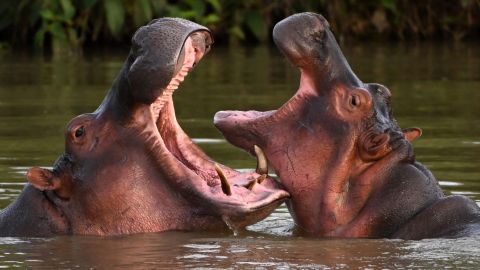
The four hippos that drug trafficker Pablo Escobar brought to Colombia in the 1980s have become a large invading herd.
According to the most recent census of the Ministry of Environment, by 2022 there were at least 169. Without a population control policy, it is estimated that by 2030 there would be more than 500 and in 2035 they would exceed a thousand.
This Monday, the Minister of the Environment in charge, Irene Vélez, announced the government’s plans to reduce the hippopotamus population, which include the euthanasia of 80 individuals of this species.
Since 2022, hippos in Colombia have been declared an invasive alien species, which means that they are considered to threaten native ecosystems and biodiversity.
Minister Vélez explained that the uncontrolled growth of the hippopotamus population, which is concentrated on the banks of the Magdalena River, contaminates the water, affects human communities and puts species such as the manatee and the river turtle at risk.
The hippopotamus is considered one of the most aggressive animals in the world, which is why it also represents a risk of attack for fishermen and residents of the area.
According to a study published in the journal animals In 2021, 87% of human encounters with hippos in Uganda between 1923 and 1994 were fatal.
Regarding the decision to provide euthanasia, Minister Vélez stated: “from a scientific perspective, this is a necessary action to be able to reduce the population.”
Translocation and euthanasia

The spherical signed this Monday allocates $7.2 billion pesos to reducing the hippopotamus population (about US$2 million) in the country. According to the minister, the expectation is that the population can be reduced by at least 33 individuals per year.
The document contemplates two ways to achieve that goal: translocation (taking hippos to zoos and sanctuaries in other countries) and euthanasia.
The government has tried to find countries willing to receive some of the hippos, but as reported this Monday it has not received a favorable response from any.
“We believe it has to do with genetic poverty and possible genetic damage that these individuals have,” Vélez said in an interview with Colombian radio station Blu Radio.
Since all individuals come from the same four Escobar hippos, their genetic diversity is very low, which increases congenital defects.
The director of Forests, Biodiversity and Ecosystem Services, Natalia Ramírez, explained that, in addition, transporting hippos to another country is very expensive.
Therefore, while they find someone willing to receive hippos and finance the transportation, the authorities decided to move forward with the euthanasia of 80 individuals.
The decision, according to Vélez, follows the recommendations of biodiversity experts and will be made in accordance with a technical protocol to ensure that it is “ethical, safe and responsible.”
The euthanasia of each individual will cost about $50 million Colombian pesos (about US$14,000), the minister reported in an interview with Blu Radio.
This does not include the burial of the body, which is essential for health reasons.
The measure promulgated by the Ministry of Environment contemplates that hippos could be killed through an injection or by a dart fired from a rifle.
The recently re-elected animal rights senator Andrea Padilla spoke out against the decision announced this Monday, calling it “easy and cruel.”
“I will never support the killing of healthy creatures; even less so if, as in this case, they are victims of irresponsibility, negligence, indolence and state corruption,” he wrote on his X account.

In the 1980s, when he reached his greatest power and wealth, Pablo Escobar established a zoo at Hacienda Nápoles with hippos, giraffes, elephants, zebras, ostriches, rhinos and buffaloes.
After his death in 1993, the farm was abandoned. Most of the animals were eventually transferred to other zoos, but none wanted to receive the hippos, which were left adrift and quickly dispersed beyond the limits of the ranch through the Magdalena River basin.
The herd of hippos in Colombia is said to be the first and only one that lives wild outside the African continent.
According to information from the Humboldt Institute, the hippopotamus population has grown thanks to the fact that they have everything they need: a lot of food and a lot of water.
Unlike Africa, where they face predators and drought, in Colombia there are no what scientists call “natural controllers” of the population.
Its rapid population growth has had a high impact on ecosystems.
According to reports from the Humboldt Institute, being a megaherbivore (usually reaching more than a ton in weight), hippos devour native flora, which under normal conditions would serve to feed smaller animals, and alter the landscape with their footsteps and the large amounts of excrement they produce.
In addition, there have been “attacks on people, persecution of people within bodies of water, fear of fishermen to carry out their work, presence of hippos on roads and occasional encounters with fishermen, children and other species,” the institute notes.
Since the beginning of this century, the Colombian government has tried different strategies to control the hippopotamus population, from killing them to chemical castration.
All so far have been ineffective in stopping population growth.
With the plan announced this Monday by Minister Vélez, the government finally seeks to reverse the curve.

click herefor more stories from BBC Files World.
Subscribe hereto our new newsletter to receive a selection of our best content of the week every Friday.
You can also follow us on YouTube, instagram, TikTok, x, Facebookand in our whatsapp channel.
And remember that you can receive notifications in our app. Download the latest version and activate them.
- Why scientists in Colombia want to kill Pablo Escobar’s hippos
- The painful agony and death of Gustavito, the only hippopotamus in El Salvador that died in a “cowardly and inhumane” attack


