
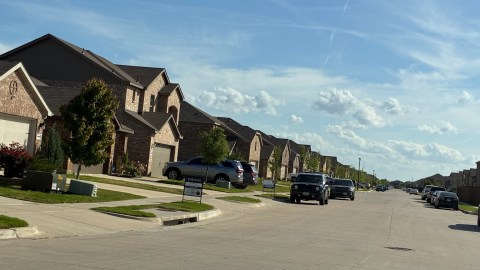
Delmi Rocsana Ramírez arrived from Guatemala to the United States nine years ago with a suitcase full of dreams; and although she wanted to reach them in California, the high cost of vision forced her and her husband to move to the state of Utah a year ago, where they already bought a house.
“For almost a decade, California was my school and the place where I put down my first roots. There I was transformed; the state opened the doors of its community colleges to me, allowing me to study, obtain basic knowledge of English and become certified in senior care (IHSS).”
This Guatemalan immigrant worked hard in the service sector as Breakfast Attendant.
“I learned the value of daily effort very early.”
However, despite her affection for California, Delmi and her husband of Mexican origin moved to the state of UTAH in January 2025.
“As a family, we faced a suffocating reality: the cost of living became a barrier to our aspirations. We saw how the high cost of rent, gasoline and taxes kept us in an endless cycle.”
He says that in California they realized that they were working to make other people’s dreams come true by paying rent, but they were not building their own.
“The transition was a plan executed with sacrifice: he moved first in January to stabilize his job and I caught up with him in mid-February.”

He recognizes that “the change was an emotional and physical blow; I went from the familiarity of the palm trees and the beach breeze to the snow of the mountains, leaving behind memories of nine years and friends who were my family.”
He says that starting from scratch has been a drastic adaptation process, from learning to navigate a different climate to changing his work focus to becoming an Inventory specialist in his new job.
For Delmi, every challenge has been worth it.
“Today, that goal that we saw as so far away is a tangible reality: thanks to that leap of faith, we are now owners of our own home. What in California would have taken us decades, here we have materialized with effort and unity.”
He shares that in his new home, along with his rescued cats, Punky and Nevada, they preserve their Latin essence and the pride of having stopped paying for other people’s dreams to cement their own.
“I look back with respect and thank California for everything it taught me. I left prepared and with my head held high, ready to conquer the mountains of Utah and show that, when there is love, support from a partner and the desire to work, Latinos always find a way to flourish, no matter how drastic the change in landscape is.”

Expelled by prices
A new study “Priced Out: Current Evaluate Finds Who Is Leaving California, The place They Trip, and Whether it Pays Off” from the California Policy Labe University of California at Berkeley reveals that Californians who leave the state tend to move to substantially more affordable communities, and are more likely to become homeowners in subsequent years.
In total, in 2025 California experienced a net loss of about 150,000 people, representing less than 1% of its 39 million residents.
The report indicates that if this becomes the new normal, the repercussions could be serious.
“A smaller population could translate into lower tax costs for building roads, fighting fires, and ensuring public safety,” the study indicates.
Likewise, it could have repercussions in the political sphere, since California would lose political weight in Congress, given that several of its legislative seats will be reassigned to those states whose population is growing.
‘Finally homeowners’
“After living for 25 years in the Solar Valley neighborhood of Los Angeles, two years ago we decided to come live in Dallas, Texas,” says Yesica Campos.
Her family included her husband, her mother, and her two adult children, ages 28 and 26.
“We were never able to buy a house in Los Angeles even if we pooled everyone’s income. We decided to come to Dallas because we were never going to have our own house there, and the rents went up a lot.”
He says that before they all moved to Dallas, his son went ahead and bought the house they now live in.
“It’s a four-bedroom house that cost us $350,000 and has a lot of land,” he says.
It’s true, he says, that wages are lower in Texas; but in California they are a little higher, and it’s not enough at all.
“It’s extremely expensive; in Los Angeles, we even tried to buy a trailer to live in, but we couldn’t,” she says.
Yesica found a job in a restaurant and half of her colleagues have moved from California to Texas for economic reasons.
“Of course, here in Texas there is not much to do. Life is calmer. We miss the food a lot, especially; and the community is different.”
But he makes it clear that he does not regret the change, and little by little they are adapting.
“Here we have money, but life is boring, without much to do; in Los Angeles, there is a lot to do but not enough to have fun.”
Jesica lives in the city of Forney, which is part of the Dallas-Citadel Price metropolitan area.
“It’s a very nice area,” he says.
A very expensive dream
The report “Priced Out: Relocation Amidst California’s Affordability Crisis” was co-written by Evan White and Policy Lab researcher Brett Fischer; and published on Tuesday, March 31.
“The price of the ‘California Dream’ has increased, and many families are leaving the state in search of more affordable places,” said co-author Evan White, executive director of the California Policy Lab at UC Berkeley.
“The impact of these moves is stark: The neighborhoods they move to are half as expensive and, as a result, they are much more likely to become homeowners in just a few years.”
The report relies on anonymous person-level data obtained from a national credit agency to look at where Californians moved between 2016 and 2025.
Additionally, the data allowed the Berkeley researchers to evaluate indicators of the financial well-being of people who moved, both before and after their moves.
“Our report reveals that people leaving California are increasingly coming from high-income neighborhoods,” explains co-author Dr. Brett Fischer, a researcher at the California Policy Lab.
“On average, these people are in a more inclined financial situation than their neighbors, and they may move in order to achieve that quality of life that they see those around them enjoying, but that they themselves cannot afford.”
Outstanding data
- On average, those who move out of state relocate to neighborhoods where housing costs — including rent or mortgage, utilities, property taxes and insurance — are about $672 per month lower.
- Rents in their new neighborhoods are about $638 (or about 30%) lower, while the median home price is almost $398,000 (or forty eight%) lower than in the communities they leave behind.
- Seven years after leaving California, former residents are approximately forty-eight percent more likely (a difference of 11 percentage points) to own a home than similarly matched Californians who remained in the state.
- The share of people leaving from higher-income neighborhoods has increased by about 6.4 percentage points (from 34% to 40%) since the pandemic.
- Californians leave for nearby states. Nevada stands out as the largest net recipient of Californians in per capita terms, followed by Idaho, Oregon and Arizona.
- It was the decline in arrivals—and not just the increase in departures—that drove the demographic decline. Between 2020 and 2025, 42 states sent fewer people to California than they did before the pandemic.
House prices fall slightly, and some take the opportunity to buy
Two jobs are not enough: young people are leaving California


