
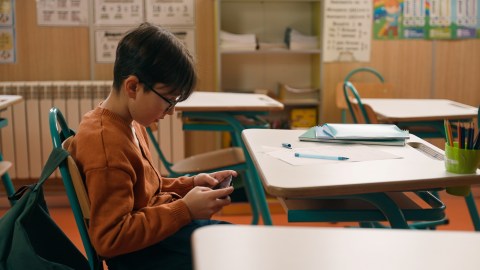
Thirty-three states have enacted laws requiring school districts to ban cell phone use in elementary and secondary classrooms.
While students are against it, studies indicate that restrictions during the work day improve learning and social interaction.
During the videoconference: Do cell phone use bans in schools benefit or harm students? Hosted by American Neighborhood Media(ACoM), several speakers debated the merits of banning cell phones versus the potential of social media to foster social connection, creative self-expression, and access to supportive communities,
Dr. Timothy Pressley, associate professor of psychology at Christopher Newport University, said the most common ban is a “bell-to-bell” ban, which is often the most effective measure to reduce distractions in the school environment.
However, he said they have observed other types of restrictions in schools, such as “instructional” bans, which prohibit the use of cell phones only during class hours, but allow students to carry them during lunch or in the hallways between classes.
He also said that there are “targeted” restrictions that prohibit phones in specific contexts, such as during exams, recess or in private classes.
Likewise, he mentioned that they have seen that some states have adopted flexible models in which schools and local school districts can choose which of these plans is most suitable for their educational centers.
“In terms of academic outcomes, the strongest evidence indicates that once the ban is implemented, academic improvements are seen, especially among low-performing or disadvantaged students.”
Notably, he said not all studies recorded academic improvements during the first year.
“For example, a study conducted in Florida did not detect any improvement in the first year, but did observe an increase in student academic performance during the second year of implementation.”
He argued that when it comes to mental health, the evidence is much more disparate.
‘A study conducted in Australia found a decrease in cases of bullying, but found no significant differences in levels of anxiety or depression.’
He also said that they have analyzed studies carried out in the United Kingdom, Sweden and Spain, which have revealed minimal or non-existent differences in levels of anxiety or depression.
Therefore, he explained that it is very difficult to draw definitive conclusions about the benefits of these measures for mental health.
“We see that students continue to use their mobile phones outside of school hours, therefore their mental health continues to be affected outside of this environment.
On the other hand, he observed that another positive finding is a reduction in interruptions within the classroom, as well as an improvement in the concentration and level of participation of the students.
He also noted that they found studies—such as one conducted in New York City—that document an improvement in interaction between students; and an increase of approximately 50% in attendance at extracurricular activities and sporting events.
However, he stated that one of the biggest concerns is the ability of parents to contact their students, especially during an emergency, whether it is a school closure or a natural disaster.
They are also worried about not being able to communicate with their children if they need to make a change in who will pick them up from class.
“In fact, one study found that mental health worsens because students experience anxiety when they are taken away.”
He said that from the teachers’ point of view, the concern is that they need the phones for certain academic activities.
Last week, a court found social media giants Meta and YouTube complicit in creating social media addiction among young people. Children and young people spend an average of 5.5 hours a day on their phones, mainly on social networks.
An obvious problem
Dr. David Marshall, associate professor of educational research at Auburn University, said surveys have revealed that 95% of students have access to a smartphone.
‘Teenagers, at least the vast majority of them, admit that they use it more than they would like.’
He explained that in the school district they worked with in a suburban area of Virginia, students were allowed to physically carry their cell phone with them; The only condition was that it remained off and stored throughout the school day, from bell to bell.
“Once the bell rings and the school day ends, the student can go outside, grab their phone and call their parents, or coordinate any logistical issues they need to resolve.”
He said that in a survey of teachers, and three months after it was implemented, they found that there were fewer distractions in the classroom; and more interaction between students in the lunch rooms, hallways, and even after school.
Phone addicts
Kai Bwor, a senior at Constitution Granada Hills School, admitted to being very hooked on his phone and checking it from the moment he wakes up.
“It kind of rewards my brain and floods me with dopamine, and technology has become our only means of social connection, it was during the COVID pandemic and it remains that way now.”
He said even if he has a school project with his teammates, he uses technology to communicate with them.
“That is so addictive precisely because many social media forums like TikTok or Instagram, as you scroll down the screen, tend to reward you with content that is more tailored to your tastes.”
He said phone addiction has caused his eyesight to worsen considerably; and because he is not allowed to go outside, he has developed a greater dependency.
According to Kai, it’s best to use the phone with clear boundaries.
“Prohibitions never lead to an effective cause; kids find ways to cheat. I see my classmates use their phones during exams or to write their essays.”
Nicholas Torres, a recent high school graduate from Houston, Texas, said he is totally against the phone ban.
“We need our phones at school because, during class time, we use them as support tools—for example, sometimes the teacher tells us to visit a certain website or use an app—and also for our homework, since all assignments are typically submitted online and are rarely done on paper and pencil.”
He maintained that another reason why he opposes the ban is because in an emergency, they use it to communicate.
Do you think cell phones contribute to isolation or, on the contrary, alleviate it?
“Sometimes the phone is like our best friend; we always have YouTube on hand, and we can watch movies, use other apps on the phone. Plus, it helps us connect with our friends and classmates; we can text each other, we have group chats, and we send each other TikToks, Instagram Reels, and things like that, even while we’re in the classroom.”
New law limits the use of smartphones during class hours
LA school district bans smartphone use, but what parents are saying


