
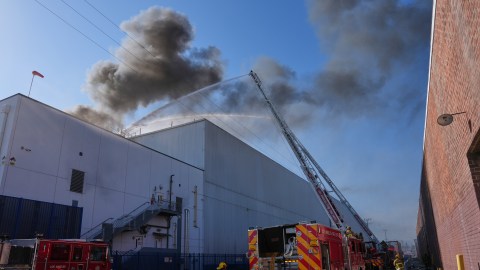
Los Angeles Mayor Karen Bass declared a state of emergency in the city yesterday afternoon to ensure that the city has the necessary resources in the coming days to continue making progress in extinguishing the large warehouse fire in Boyle Heights, which has caused columns of irritating smoke throughout the region.
“While the Los Angeles Fire Department (LAFD) continues to move forward, this is a serious incident involving multiple jurisdictions. I am declaring a state of emergency to ensure the city has the necessary resources while this operation continues and to keep the community safe,” stated Mayor Bass. “The city and county have made spaces available for families seeking shelter from the smoke, and we will continue to work tirelessly and do everything we can to completely extinguish the fire.”
Since Friday, fire crews have been battling a resurgence of the fire at the Lineage Logistics cold warehouse in Boyle Heights. A mix of black and white smoke emanated from the building as firefighters worked to extinguish the fire.
“This emergency declaration is crucial because Boyle Heights is not just responding to a fire. Residents have experienced days of smoke, shelter-in-place orders, disruptions to their daily lives, and constant questions about the consequences for their health and well-being. Boyle Heights deserves clear information, direct support, and full accountability throughout the response, cleanup, and recovery process,” said Ysabel Jurado, Councilwoman representing Boyle Heights.
The fire started shortly before 2:30 p.m. Wednesday at a cold storage facility located in the 1400 block of South Los Palos Avenue. The Los Angeles Fire Department described the massive fire as a very complex incident that posed numerous risks to firefighters.
Los Angeles Fire Department (LAFD) Battalion Chief Nicholas Ferrari said residents should expect the fire to “have ups and downs.”
“You’ll see this fire has ups and downs and different smoke conditions,” he said at a news conference Friday night. “The smoke will dissipate and it will appear that we have put out the fire, but 10 minutes later it could reignite.”
According to firefighters, a change in wind conditions caused the fire to reignite inside the building, which had continued to smolder after its roof, covered in solar panels, caught fire earlier this week.
Lineage, the company that owns the Boyle Heights facility, issued a statement saying the fire was caused by contractors working on solar panels installed on the rooftop.
“At this time, we believe the fire started while contractors for the third-party owner of the solar panel system located on the facility’s rooftop were conducting testing,” the statement read.

The fire at the cold storage facility continues to be actively attended to by emergency personnel. And although the fire is located within the city of Los Angeles, nearby unincorporated communities in East Los Angeles, which are under the county’s jurisdiction, are experiencing significant impacts, including smoke and air quality issues.
This morning, First District Supervisor Hilda L. Solís announced the opening of a temporary shelter in Metropolis Terrace Park, in East Los Angeles, located at 1126 N. Hazard Avenue, for affected residents to protect themselves from the smoke.
Although there is currently no evacuation order in effect, residents affected by the smoke are encouraged to use the shelter as a safe place where they can access cleaner air, as well as resources and support services, while firefighting operations continue. The shelter will provide masks, bottled water, non-perishable food, and information from public health and air quality authorities. Transportation assistance, including transportation coordination, will also be offered to help residents safely reach the location.
Another center that opened is the Pecan Recreation Center, located at 145 Pecan Street. Where they can find some shelter while they manage to control the fire. Local groups like Coyotl wan Macehualli are also raising funds to purchase Corsi?Rosenthal Field air purifiers and distribute them to neighbors affected by the Boyle Heights fire.
Residents in the area are encouraged to wear masks when going out and to stay home or indoors when not required to go out.
“We know this is concerning. It’s an inconvenience, but we’re doing everything we can to resolve it as quickly as possible and we want everyone to be safe in the meantime,” Los Angeles Mayor Karen Bass said at a news conference Friday night.
Governor Gavin Newsom yesterday declared a state of emergency for Los Angeles County in response to the active warehouse fire in the Boyle Heights area. The measure directs state agencies to support local response efforts and help protect public health and safety.
The emergency proclamation authorizes the California Governor’s Office of Emergency Services (Cal OES) and other state agencies to provide additional assistance and resources, as needed, to support response and recovery efforts, as well as mitigate impacts to nearby communities.
“California is mobilizing to support Los Angeles as firefighters and emergency personnel continue to work to control this fire and protect surrounding communities,” the governor said in a statement.
Resources available from the California government include: 5.5 million N95 respirator masks available for distribution to affected communities, commercial-grade air purifiers available for evacuation centers, community facilities and other public spaces, bottled water and other emergency supplies available through the state’s logistics network, and enhanced air quality monitoring and technical support resources.


