
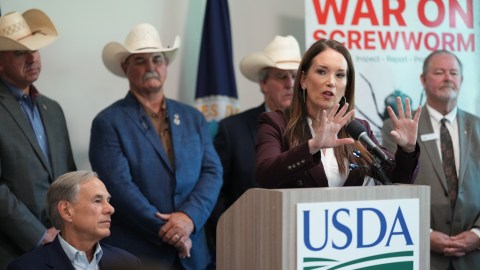
Agriculture Secretary Brooke Rollins rejected that cuts to international aid programs by the United States Agency for International Development (USAID) have contributed to the reappearance of the New World screwworm in the United Statesa plague that had been eradicated from the country more than six decades ago.
During a visit to La Pryor, Texas, Rollins responded to criticism about the elimination of funding for plague surveillance in Central America, stating categorically: “That has absolutely nothing to do with it.” The official maintained that, on the contrary, the United States Department of Agriculture (USDA) has substantially strengthened its response capacity.
“When we arrived there were only ten full-time employees focused on screwworms. Just a month or two ago we had more than 120 employees dedicated to this matter. That represents a 1,000% increase.” declared Rollins, who added that the federal agency has allocated greater resources to prevent the spread of the parasite.
.@SecRollins on efforts to fight and eradicate the Fresh World Screwworm: We accept moved the discovering out from Iowa to our contemporary facility in Texas. The upcoming Edinburg, TX facility will give us about 300-400M sterile flies. We opened a brand unique dispersal facility that lets in us to? pic.twitter.com/c9bdvgbBlm
— Rapid Response 47 (@RapidResponse47) June 11, 2026
Rollins’ statements respond to questions from state officials and representatives of the livestock industry, including Texas Agriculture Commissioner Sid Miller, who have suggested that failures in surveillance systems allowed the screwworm to advance into the United States, given that among the thousands of canceled programs was an initiative aimed at preventing the spread of the screwworm in the border region, which fueled the debate about whether the reduction in resources could have affected preventive efforts.
However, the secretary insisted that the federal response has been rapid and that the increase in specialized personnel demonstrates the government’s commitment to containing the plague.
Confirmed cases and federal response
Federal authorities have confirmed multiple screwworm infections in Texas and New Mexico, activating quarantine protocols, restrictions on animal movement and epidemiological surveillance measures.
The USDA has reiterated that the parasite poses a serious threat to livestock, pets, wildlife and even, in rare cases, for humans.
Likewise, it has reported that it continues to use the strategy of releasing sterile flies, considered the most effective tool to interrupt the reproductive cycle of the insect. Various officials have indicated that they hope to contain the cases detected and avoid a widespread infestation.
What is the screwworm and why is it a concern?
The New World screwworm (Cochliomyia hominivorax) is not a worm itself, but the larva of a fly that lays its eggs in open wounds or natural cavities of warm-blooded animals. When they hatch, the larvae feed on living tissue, causing deep lesions, serious infections and even death of the animal if it does not receive timely treatment.
Specialists and authorities warn that a widespread spread of the screwworm could cause multimillion-dollar losses for the US livestock industry. Texas is home to the largest inventory of cattle in the country and is a mainstay of national beef production, so a sustained outbreak would impact productivity, increase health costs and could further pressure beef prices.
In addition to the economic impact, the expansion of the parasite has led to strengthening health controls and trade restrictions related to the movement of live animals between the United States and Mexico, while investigations continue into the origin and scope of the cases detected.


