
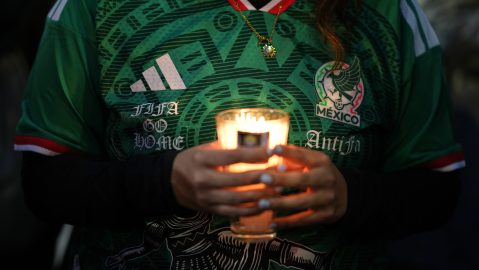
Mexico, with 17 participations, It is among the five countries that have attended a soccer World Cup the most times, but he is the only one of these who has not won it.
It can be said another way, perhaps more tortuous: Mexico is among the 10 countries that went to the most World Cups, but it is the only one of them that has not reached a semifinal.
We can continue: Mexico has played 60 games in the World Cup and obtained only 17 victories. He has scored 62 goals and conceded 101. Not even the United States, his eternal and supposedly insulting rival, has such a negative goal difference.
In its first three participations—1930, 1950 and 1954—Mexico lost every game. Their first point – and the last in that World Cup – was against Wales, in 1958, after a 1-1 draw. In 1986 was the last time they reached the quarterfinals.
Hard data that, however, fail to undermine the fervor of the Mexicans, who starting this Thursday will be the first to host three World Cups.
This is, without a doubt, a football country.
On Saturday, tens of thousands of people took to Reforma Avenue to recreate what they called “the biggest wave in the world”, between harangues of “we are the best country”, “we are going to win” and the essential “yes we can”.
The Mexican Juan Villoro writes in his recent book, “Numbered Heroes”: “No country has provided so much emotion in exchange for so few results.”
What’s up, then, with Mexican soccer?

The problem of those in “long pants”
Although we start from the idea that they are related, let’s start by looking at club football before entering the national team, the “Tri”.
Anyone who asks you about the limitations and oddities of Mexican soccer will answer more or less the same: they are the institutions.
Football is, everywhere, a business of monopolies, opaque market laws and corporate interests. But Mexico, according to the analysts consulted, is another level.
Roberto Gómez Junco, former soccer player and journalist, puts it this way: “The fundamental problem of Mexican soccer continues to be in those in long pants, in the leaders.”
And Marion Reimers, also a sports journalist, adds: “It is a football that very quickly moved away from the partner or shareholder model that exists in many countries.”
Therefore, the corporate ownership of the teams predominates, which are managed with economic criteria rather than identity. It is not that they are autonomous companies, as is the case in England: they are arms or subsidiaries of corporate giants.
Added to this is that the treasury of each state also introduces money to the teams: political criteria also weigh.
Reimers gives a perhaps unique example of Mexican soccer: teams change headquarters as they change sponsorship, as happens in some sports leagues in the United States.
Monarcas de Morelia, for example, today is called Mazatlán FC; changed its name, coat of arms, colors and state. The Morelians, suddenly, were left without a team.
It is not the only case: Toros de Neza is now the Atlante; They went to Querétaro, then to Cancún and now they returned to Mexico City. Jaguares de Chiapas today is FC Juárez: they went from the extreme south to the extreme north of the country.

In the recent Club World Cup, a tournament of regional champions organized by FIFA, León – champion of the Concachampions in 2023 – was disqualified because Pachuca – also champion of the regional tournament in 2024 – was owned by the same owner.
To avoid conflicts of interest and competitive manipulation, FIFA, as well as UEFA in Europe, prohibits the same company or person from having two teams in the same competition.
An attempt has been made to change it, but co-ownership continues to be a structural condition of Mexican soccer: eight of the 18 first division teams are today controlled by four companies.
Televisa, the largest audiovisual production company in the world in Spanish, became the owner of three at the same time: América, Necaxa and San Luis. It had the rights to broadcast football. And it is the owner of the Azteca Stadium.
In 1986, when Colombia resigned from organizing the World Cup, an alliance between businessmen from Televisa, FIFA and the Mexican Football Federation (FMF) managed to make Mexico host for the second time. The case, full of twists and turns of power, was adapted into a recent Netflix film starring Diego Luna.
It is one of those undeniable facts that may hurt many Mexicans: Mexican soccer was developed, in part, as a Televisa business. And that conditioned the competitiveness of the game.
América, the winningest team in history, was bought by Televisa—then Telesistema Mexicana—in 1959; From there it became the largest thanks to a media company that, meanwhile, served as a kind of ally of the Institutional Revolutionary Party (PRI) regime, in power for 70 years.

“Mexican soccer is planned to be an economic success and a sporting failure,” Villoro writes.
Liga MX, which until this year was – another Mexican rarity – a branch of the FMF, makes between US$600 and US$700 million a year. Half that of the Brazilian league, the largest in Latin America, and double that of Argentina.
Mexican soccer is so marked by business that, since 2020, in the middle of the pandemic, Liga MX eliminated the promotion system, that is, the last team in the table goes to the second division at the end of the season and the first in the second goes up to the first.
Whoever wants to be in the first, pay. That only happens, with nuances, in Chinese, Indian and American soccer.
“What roots are you going to have in a game where there is no meritocracy or clear rules?” Reimers asks.
“Actually, it is a miracle that Mexico continues to be a soccer country,” he says.

More than a sport
Another condition of Mexican soccer—no longer necessarily a problem—is that it belongs to the Confederation of North America, Central America and the Caribbean (Concacaf), considered less attractive and competitive than the Union of European Football Associations (UEFA) and the South American Football Confederation (Conmebol).
That may have generated a certain inflated self-perception among some and in any case it has allowed the men’s team to qualify for many World Cups without major opposition. But it has also put the women’s team to play against the great power, the United States.
“Women’s soccer has grown a lot, it is one of the most watched leagues in the world, and that has been not because of the interest of the owners, but thanks to their disinterest,” says Reimers.
Mexicans have not found corporatism or poor results a reason to stop encouraging.
The match against Argentina at Qatar 2022, which Mexico lost 2-0 and was on the brink of elimination, was the most watched event in the history of Mexican television, with 40.5 million viewers, according to Nielsen.

The FMF reports that each Liga MX match is watched by 22,000 people on average. In Argentina and Brazil, to compare with very soccer-loving countries, the average attendance at the stadium is 27,000 and 23,000, respectively.
The numbers are not very different for television: each game is tuned in by an average of 1 million in Argentina, 3.5 million in Brazil and 1.5 million in Mexico.
Juan Pablo Villalobos, writer and regular fan, assures: “I don’t think we are mediocre. We are not; we are average, and it is very good being the country we are, considering our shortcomings, our problems and our deficiencies.”
Then he adds: “The national team represents us almost perfectly: on specific occasions it is brilliant, we grow against great players, but in the end something has always been missing, sometimes luck, sometimes determination or an extra point of quality.”
That missing point cannot be attributed to the fans.
Villoro maintains that “the real sport is not on the field, but in the stands, where the public makes more effort than the players.”
Mexicans feel tremendous pride in their country and do not lose any pretext to express it.

Gómez Junco sees this as a risk: “Mexico has traditionally been a defeated country and football becomes a get away valve, an evasion mechanism. If people do poorly at work and do not feel secure but have the illusion that their team can be world champion, then I will sell them that dream.”
Reimers adds that corruption or corporatism are no reason for her, or any Mexican, to stop being interested in the game known as “the most beautiful sport in the world.”
“Football is not FIFA and FIFA is not football, it does not belong to them. It is a human activity subject to interpretation and modification. It is a territory that we have and we can inhabit from whatever narratives we want,” he says.
Mexican soccer may lack sporting successes, but soccer is much more than a sport.
The powerful Mexican cultural legacy, inevitably and constantly under siege by the influence of its northern neighbor, the largest economic power in the world, has generated a deep nationalist tradition that manifests itself whenever it can.
It’s not that, when they say they are going to win the World Cup, Mexicans believe that they will: it’s that the pride they feel for their country is not measured in goals or trophies.

click here to watch more stories from BBC Data Mundo.
Subscribe here to our new publication to receive every Friday a selection of our best content of the week.
You can also follow us on YouTube, instagram, TikTok, x, Facebook and in our whatsapp channel.
And remember that you can receive notifications in our app. Download the latest version and activate them.


