
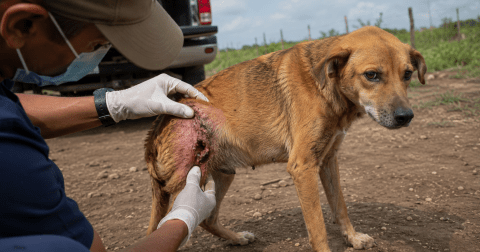
Texas reinforced the alert for the New World screwworm, a pest that can cause serious injuries to livestock, pets and wild animalsand which ignited the response of state and federal authorities after the confirmation of cases in animals.
The issue is of particular concern to the livestock sector, but it also raises an inevitable question for the population: Can it affect humans? The response of the health authorities is clear: sIt can occur, but it is rare, and so far no human infestations have been reported. purchased locally in the United States.
He United States Department of Agriculture confirmed on June 3, 2026 the presence of the New World screwworm in a calf from Zavala County, Texas. Since then, the state expanded emergency and surveillance measures to prevent the plague from establishing itself in the country again.

What is the New World screwworm?
The New World screwworm is not a common worm, but the larva of a parasitic fly known scientifically as Cochliomyia hominivorax.
Unlike other larvae that feed on dead tissue, these larvae can penetrate open wounds and feed on living tissue. That can cause serious injuries, secondary infections, loss of animals and heavy economic damage for livestock producers.
The Animal and Plant Health Inspection Service of the US Department of Agriculture (USDA) considers it a serious pest because It can affect livestock, pets, wildlife, and, less commonly, people and birds.
What cases were confirmed in Texas
The first USDA-confirmed detection in this outbreak occurred in a three-week-old calf in Zavala County, south Texas.
The Texas Tribune later reported new confirmed cases in the state and the appointment of John Bellinger, a member of the Texas A&M University Board of Regents, as senior advisor for screwworm preparedness. Their role will be to explore available technologies to combat the plague.
Can screwworm affect humans?
Yeah, It can affect humans, but cases are rare and the staunch risk in the United States remains low, according to the CDC.
The parasite can infesting open wounds or mucous membranes of warm-blooded animals. That includes livestock, pets, wildlife and, to a lesser extent, people. CDC reported that no locally acquired human infestations have been reported in the United States during the current outbreak.
Even so, authorities recommend not ignoring suspicious injuries. A wound with maggots, increasing pain, bad odor, discharge or damaged tissue should be evaluated by a doctor. In animals, any suspicion should be reported immediately to a veterinarian or animal health authorities.
You can see: Sheinbaum sees the US decision to close the border due to screwworm as “unfair”
Why it worries farmers and pet owners
The main threat is in animals. Flies can lay eggs in small wounds, cuts, navels of newborn animals, or skin lesions. When the larvae hatch, they begin to feed on living tissue. If not detected and treated in time, the infestation can progress rapidly and cause severe damage.
For ranchers, the risk is not only health. An advance of the screwworm can cause movement restrictions, quarantines, increased veterinary costs, productive losses and economic damage in rural areas.
For pet owners, the recommendation is to check wounds, keep them clean and consult the veterinarian. if unusual signs appear.

What is Texas doing?
Governor Greg Abbott issued a New World screwworm disaster proclamation on June 5, 2026. The measure seeks to accelerate state coordination, strengthen emergency response, and support surveillance, detection, and wait-and-see actions.
According to authorities, the pest poses a risk to livestock, agriculture, wildlife and the Texas economy. That’s why they recommend frequently checking farm animals, pets, and wildlife in care, especially if they have open wounds.
Warning signs may include visible larvae, bad odor, inflammation, bleeding, discharge, irritation, pain, or unusual behavior of the animal.
In case of suspicion, it is not recommended to try to solve the problem without reporting it. Producers should contact a veterinarian, the Texas Animal Effectively Being Commission, or USDA APHIS to activate appropriate protocols.
In humans, the recommendation is to seek medical attention if a wound worsens, has larvae, or shows signs of infection. Although the staunch risk for people in the United States is low, early detection is key.
Continue reading:
Influenza D and the canine coronavirus: two viruses that could cause the next pandemic
More than fifty restaurants have closed in Los Angeles due to pest and rodent infestation
The Industries Where ICE Typically Raids the Most Workplaces


