
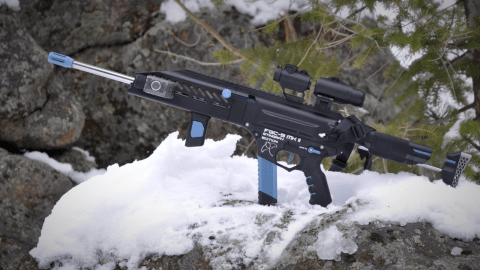
Senior officials of the United Nations (UN) issued a serious warning, warning about how Technological advances are allowing the proliferation of so-called “ghost weapons.” These devices, manufactured using three-dimensional (3D) printing, lack serial numbers and are impossible to track by law enforcement.becoming the new engine of violence, organized crime and global instability.
The alarming panorama is analyzed in New York, where delegates from around the world meet to stop the illicit trafficking of firearms. According to experts, The danger no longer lies solely in the arsenals abandoned after the end of a war, but in the ease with which criminal and terrorist networks adopt digital technology to manufacture weapons. from any corner of the planet.
Concern about this phenomenon recalls the warning made years ago by Kofi Annan, who described small arms as the true “weapons of mass destruction” due to the enormous number of victims they cause around the world.
Given this scenario, The United Nations has called for strengthening international cooperationupdate regulatory frameworks and develop mechanisms to address the challenges posed by 3D printing and other emerging technologies.
From the battlefield to the streets: the untraceable danger
“Wars end, but unfortunately the weapons that were used in that particular conflict are not under defense in their entirety,” said Izumi Nakamitsu, senior UN official for Disarmament Affairs. The clearest example of this lethal legacy is Libya, where weapons looted after the fall of Muammar Gaddafi in 2011 ended up crossing borders to feed extremist groups in Niger, Burkina Faso and Nigeria.
However, 3D printing has changed the rules of the game drastically.. As printer costs become cheaper, with commercial models starting at $600, and plans become more widespread on the Internet through platforms such as DEFCAD (dubbed the “Netflix of weapons”), anyone can press a button and manufacture a rifle.
Unlike conventional weapons, 3D printed weapons do not leave identifiable marks on the casings or bullets, erasing any possibility of authorities using ballistic databases to solve a crime. In addition, being constructed mainly with plastic polymers, they easily evade security controls and X-rays..
Deserts libyens aux arms imprimées en 3D, ces arsenaux qui survivent aux wars
The UN is responsible for the disarmament questions, @INakamitsu, is concerned with the proliferation of light and small caliber weapons (#BMS9)https://t.co/rpPn7omhSy
— ONU Recordsdata (@ONUinfo) June 4, 2026
The connection with the cartels and the challenge in the US
The impact of this technology is already being strongly felt in the United States and on the southern border. According to ATF data, ghost gun seizures in the United States skyrocketed 157% in just two yearsgoing from 7,517 in 2019 to 19,344 in 2021. DEA reports confirm that members of gangs and street groups are increasingly turning to these privately manufactured parts purchased online.
The threat crosses directly into Mexico. Intelligence reports reveal that “manufacturers” based in states with more permissive laws, such as Nevada and Texas, actively advise criminal organizations such as the Sinaloa Cartel and the Jalisco New Generation Cartel (CJNG).
Cartels use 3D technology to reduce their dependence on traditional border smuggling, manufacturing everything from components for heavy weapons to devices such as Glock Switcheswhich convert semi-automatic pistols into lethal bursts for a production cost of less than two dollars.
The problem is aggravated by legal loopholes. While in Europe and the United Kingdom the possession of these plans and parts is strictly prohibited, In the United States, the Undetectable Firearms Act of 1988 allows certain loopholes if the devices include metallic components, making it easier for the homemade weapons business to continue to prosper underground.
For experts, the goal is not only to control weapons, but to prevent conflicts from reactivating, protect communities and reduce the violence that continues to claim lives long after wars end.
Keep reading:
- The use of 3D printed firearms could increase among criminals and extremists
- Mexican drug traffickers acquire one of every two Barret rifles sold in the US, according to a report
- The Postal Service could be used to legally ship guns to anyone in the US.


