
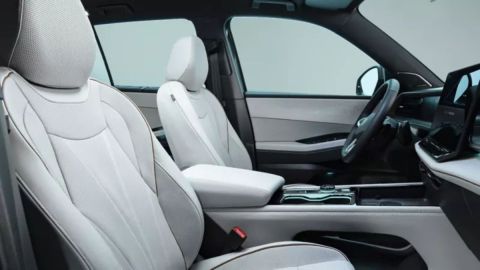
When families take a trip, the argument often revolves around who is in the front and who is in the back seats. What few consider is that this choice can have a direct impact on the safety of each occupant.
Read also: Volvo makes Gemini a much more useful co-pilot
Although modern cars incorporate more and more protection systems, the position occupied by each passenger continues to be an important ingredient in the event of an accident.
You can look: There is controversy: experts question Tesla’s safety figures
Road safety studies and analyzes agree that some places inside the vehicle offer a clear advantage over others.
The position with the greatest protection
Various research indicates that the middle seat of the second row is usually the safest place to travel.
The reason is relatively simple. This location is furthest from the areas that typically receive the first impact in a frontal or side collision. That extra distance can reduce the chance of serious injury.

For this reason, many specialists recommend that children travel in that position as long as the vehicle has a three-point belt and adequate systems to install a child seat.
When the center seat does not have the necessary conditions, the place behind the front passenger is usually considered a good alternative.
The seat that presents the most risks
At the opposite end is the right front seat. According to various analyzes of traffic accidents, the front passenger is more exposed in certain types of impacts, especially frontal ones.
In addition, some experts point out that, when faced with a sudden maneuver to avoid an obstacle, the driver’s instinctive movements can leave that side of the vehicle more inclined.
This does not mean that traveling there is unsafe in absolute terms. Today’s cars feature airbags, advanced seat belts, and impact-absorbing structures that offer high levels of protection. However, statistically it is not usually the most favorable place.
The evolution of security
For a long time it was assumed that any rear seat was considerably safer than a front seat. However, technological advances have reduced some of that difference.
Manufacturers have developed more sophisticated airbags, belts with better retention systems and structures capable of better protecting front occupants.
Even so, for small children, rear seats continue to be the most recommended option when restraint systems appropriate for their age and size are used.

Small details that make a big difference
Beyond the chosen location, safety also depends on how each occupant travels.
Correctly using the seat belt continues to be one of the most effective measures to reduce injuries. It is also classic to properly adjust the seat and maintain a correct posture while driving.
In the case of the driver, it is recommended to maintain sufficient distance from the steering wheel, keep the backrest relatively straight and adjust the height to obtain good visibility of the road.
Ultimately, there is no such thing as a completely risk-free position.. However, choosing correctly where to sit and using safety systems appropriately can make a significant difference when an accident occurs.
Continue reading:
Kia begins production of the 2027 Sportage Hybrid in the US
The Tesla Mannequin Y wobbles: an electric SUV challenges it
The new AC GT Coupé mixes nostalgia and 799 horses


