
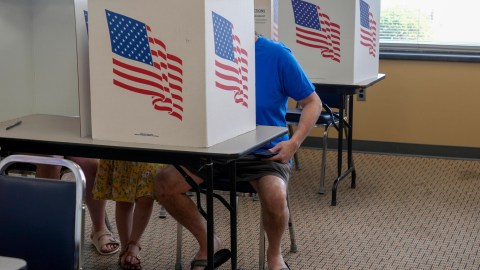
Some of the candidates supported by President Donald Trump won the primary elections on June 2, but the Republican president had significant defeats, the most worrying for his MAGA movement being what happened in Iowa.
In the Republican race for governor in Iowa, businessman Zach Lahn defeated U.S. Rep. Randy Feenstra, who had received Trump’s endorsement just days before the election.
Despite that defeat, Trump managed to win over US Representative Ashley Hinson, the Republican candidate for the US Senate who, in November, will face Democrat Josh Turek, who won his party’s primary.
However, that election was not the only one, since voters went to the polls this June 2 also in California, Montana, New Jersey, New Mexico and South Dakota, to define candidates who will compete in the legislative and state elections in November.
California
California voters went to the polls to define the race for governor and dozens of federal and state offices ahead of the November general election.
The state operates under the “open primary” or “top two” system, where the two most voted candidates advance regardless of their party affiliation. In the race there is a close competition to succeed Democratic Governor Gavin Newsom, with former federal secretary and former state attorney general Xavier Becerra and conservative commentator Steve Hilton leading.
The day also included elections for the House of Representatives, the state Legislature and various local offices, in a process closely watched by both parties due to its possible impact on the balance of power in the federal Congress.
New Mexico
New Mexico voters had to define the candidates who will compete for governor and other federal, state and local offices.
The race to succeed Democratic Gov. Michelle Lujan Grisham, who cannot seek a third consecutive term, focused much of the attention. In the Democratic Party, the former Within Secretary of Joe Biden’s government, Deb Haaland, won the nomination for governor after beating other candidates, while the mayor of Rio Rancho, Greg Hull, won the Republican nomination.
Although Trump did not issue a formal endorsement in the gubernatorial race, the Republican primary was marked by issues related to his agenda, such as border security, fighting crime and reducing taxes.
Among the candidates supported by Trump in the state, Republican Greg Cunningham, congressional candidate for District 2, stood out, who received the president’s public support on the eve of the election.
The day also included primaries for the federal House of Representatives, the state Legislature and other public offices, in an election that also marked the debut of the state’s semi-open primary system, allowing the participation of independent voters in the processes of the main parties.
Mountain
In Montana, Republicans turned their attention to the Senate race after the departure of Sen. Steve Daines. Kurt Alme positioned himself as a favorite for the Republican nomination.
One of the most watched races was House District 1, where Republican Aaron Flint, a former radio host and strong ally of President Trump’s policies, sought the nomination with the president’s explicit support.
Trump also endorsed U.S. Rep. Troy Downing, who advanced unimpeded in District 2, and former U.S. Attorney Kurt Alme in the Senate race, after Sen. Steve Daines surprised by withdrawing from the race and endorsing him.
South Dakota
South Dakota Governor Larry Rhoden will face businessman Toby Doeden in the Republican primary runoff as he seeks a full term.
Rhoden was the state’s lieutenant governor and replaced Kristi Noem last year when she joined the Trump administration.
Among the most watched races was the state’s House seat, where Attorney General Marty Jackley won the Republican nomination after defeating James Bialota. Jackley had the backing of Trump, who had also expressed support for Republican Sen. Mike Rounds in his re-election campaign and other Republican candidates in the state.
The primary reflected Trump’s strong influence within the Republican Party in South Dakota, a state that remains among the strongest conservative strongholds in the country.


