
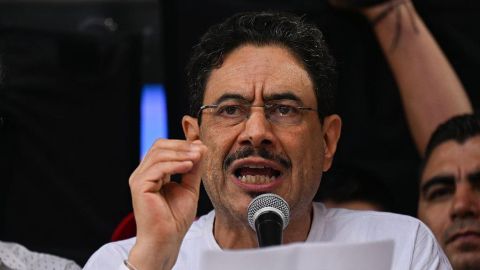
The day his father was killed, Iván Cepeda sent Colombia a message so forceful that it ended up marking his career.
Manuel Cepeda Vargas, senator of the leftist Patriotic Union party, had been shot inside a car in the southwest of Bogotá in a crime attributed to paramilitaries in collusion with state agents.
Expertise August 9, 1994.
Iván, 31 years old, arrived at the scene minutes later and made a plea against the political violence from which no ideology was spared at the time, but which was carried out against the left.
“I ask the country, the president (Ernesto) Samper, those who have to do with justice in Colombia, to do something against this offensive against the left-wing leaders; and that this crime does not go unpunished like that of so many just and brave men who have fought in this country,” he said before the cameras.
Cepeda put aside his loss to speak to the nation that he now aspires to govern after finishing second in the first round this Sunday and moving on to the June 21 runoff.
The candidate called to succeed the left-wing progressive path started by Gustavo Petro in 2022 will face the right-wing lawyer Abelardo de la Espriella.
Cepeda, 63 years old and senator from the Historical Pact party, obtained 41% support compared to 44% for his rival.
The Uribe trial and the coup de effect
Until a few months ago, few saw Cepeda as a candidate. Not even himself, who denied any presidential aspiration to his circle.
A man described by those close to him as calm, thoughtful, firm and patient, who in his free time practices pottery at home, dedicated himself exclusively to working for the victims of the historic armed conflict in Colombia, negotiating with guerrillas to try for peace and investigating paramilitarism.
On August 1, 2025 everything changed. A Bogotá court in the first instance sentenced former president Álvaro Uribe Vélez to 12 years in prison for bribery in criminal proceedings and procedural fraud.
Cepeda was a victim and witness in that trial that has lasted more than 13 years and whose goal is for the candidate to find the truth about Uribe’s alleged links with paramilitaries.
After what was considered a victory for Cepeda against possibly the most powerful politician in the country, part of public opinion turned to his desire. “Cepeda president,” was read on social networks.
I asked him about it hours after the sentencing. Laughing, he told me that the trial seemed easier to him and that he was contemplating a previously unthinkable decision.
Petitions and letters accumulated in his email in which followers, victims’ associations and sympathizers asked him to run for president.
“I have to do it,” he told a friend over lunch.
The Superior Court of Bogotá acquitted Uribe on October 21.
Cepeda filed an appeal, prolonging the dispute, but in those days he was facing a larger company. Five days later he participated in his party’s internal consultation and won comfortably.
Most polls show him as the favorite for the presidency since then.

A socialist dedicated to victims and peace
Cepeda’s character and career were forged between exile and tragedy.
His family lived abroad on several occasions, such as in Czechoslovakia and Cuba, due to the frequent threats suffered by their ideology.
Iván’s mother, Yira Castro, was a renowned journalist and Communist Party politician. He died of a serious illness in 1981.
The candidate was 19 years old. Months later he traveled to Bulgaria, where he graduated in philosophy.
His stay in the Soviet bloc marked him. “Cepeda is the son of the perestroika“, writer Federico Díaz-Granados, close to the family, tells BBC Mundo.
The perestroika was a reform led by leader Mikhail Gorbachev to modernize and restructure the economy of the Soviet Union (USSR) in the late 1980s.
It was the prelude to the decomposition of this block in 1991 and the cause of friction between Cepeda and his father shortly before his death.

“Iván returned from Bulgaria with a reformist and modern vision of socialism that distanced him from Manuel’s communist orthodoxy. They disagreed a lot,” says Díaz-Granados.
Years before his father’s death, Cepeda experienced the murders of José Antequera and Bernardo Jaramillo Ossa, two prominent leftist leaders whom he approached after returning to Colombia.
Cepeda admits not remembering a time in his life without the threat of death, which intensified after he began seeking justice for his father and other murdered leftist politicians.
He went into exile one last time in France between 2000 and 2003, where he studied a master’s degree in International Humanitarian Law.
Upon returning, he resumed his search for justice and reparation for victims, delved into the origins of paramilitarism and began a defense of human rights that he maintains to this day.

Elected as a representative to the Chamber in 2010 and senator since 2014, he was a facilitator of the peace talks between the government and the FARC that led to the demobilization of this guerrilla in 2016.
It has also participated in negotiations with other armed groups such as the ELN and is an active part of the Petro government’s ambitious “total peace” strategy, questioned by critics for failing to achieve the promised results.
He is currently married, without children, to the anthropologist Pilar Rueda, also a human rights, justice and gender worker.
Cepeda vs Petro
Political opponents point to Cepeda as “a more radical man than Petro” who worries part of the business sector.
Its approach does not differ much from the Petrista ebook: social reforms, more prominence of the State in the economy, peace with armed groups without giving up dialogue, and transformed institutions to combat clientelism and reinforce democratic participation.
Cepeda has supported the president’s idea of calling a Constituent Assembly to reform the Constitution, a divisive issue in a country reluctant to make major changes.
He has also spoken out against decisions and policies of institutions such as the Bank of the Republic and the National Electoral Council, generating criticism from part of the public opinion for allegedly violating the separation of powers.

León Valencia, political analyst, friend of Cepeda and author of the biography Iván Cepeda: a life against oblivion (Aguilar, 2026), believes that there is resentment against the candidate due to his political affiliation; his rivalry with Uribe, whom many praise in Colombia, and an ideological firmness greater than that of Petro.
Even so, Valencia pictures him as less confrontational and radical than the president, without “messianic or caudillo” airs, of “Zen patience” and “more conciliatory and calm.”
At the same time, he notes his lack of executive and management experience in public positions as disadvantages of his candidacy.
Another criticism against Cepeda, fueled by the opposition, is his alleged degree of connection to the guerrillas.

“The FARC candidate,” his opponents frequently say, without Cepeda seeming to flinch when the accusations are made in public.
To date there has been no conclusive evidence of any nexus to support the accusation. Valencia normalizes that a man who has dedicated himself to mediating between armed groups and the State has maintained contacts with guerrillas.
Cepeda acknowledged having received information about pressure exerted by armed groups on the electorate in some territories of the country and condemned “categorically and energetically” these actions.
That his program continues the reforms initiated by Petro also generates reluctance among some economists.
They are concerned about the fiscal crisis facing Colombia, partly conditioned by the increase in public spending.
“Cepeda will have to make economic and social adjustments to reassure the country,” says Valencia.
A coherent and risky formula
In the era of social networks, where Petro took advantage by turning them into a political balcony where he exhorts his masses, criticizes opponents and sets the agenda, Cepeda sticks to a more traditional approach.
He challenges his progressive, racially diverse electorate from areas considered “forgotten by the State”, with speeches in public squares that appeal to continue the path of change begun in 2022.
The slogans against exclusion, inequality, corruption and violence are repeated in his speeches. In X he is more brainy than passionate.
Political scientists highlight that his vice-presidential choice, senator and indigenous leader Aida Quilcué, showed coherence with his message and the formula that worked for Petro by appointing Afro-Colombian activist Francia Márquez as vice president four years ago.

Like Márquez, Quilcué represents that Colombia frequently ignored by the old political elites and on which the Historical Pact is committed.
Like Cepeda, Quilcué is also a victim of state crimes. Her husband, Edwin Legarda, was murdered in 2008 by members of the army in the department of Cauca.
Cepeda’s choice was risky. It was interpreted that the candidate would focus on his own without seeking to seduce centrist voters.
His chances of victory have been reinforced by the legacy of Petro, who despite navigating corruption and ministerial, diplomatic and security crises, reaches the closing stretch of his mandate with notable popularity.
Cepeda seeks to become the first victim of state crimes to lead the country and prolong Colombia’s leftist turn amid the conservative wave sweeping Latin America.

click hereto investigate cross-check more stories from BBC News Mundo.
Subscribe hereto our new e-newsletter to receive a selection of our best content of the week every Friday.
You can also follow us on YouTube, instagram, TikTok, x, Facebookand in our new whatsapp channel.
And remember that you can receive notifications in our app. Download the latest version and activate them.
- Who are the candidates for the presidency of Colombia and which Congress will the next president meet after the results of the legislative elections?


