
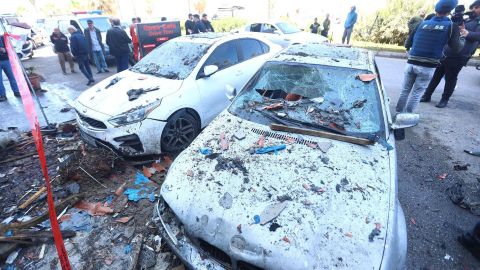
The Israeli army carried out a wave of airstrikes throughout Lebanon this Wednesday, leaving a high number of dead, overwhelmed hospitals and possible victims under the rubble of collapsed buildings.
Israel described this action as the largest airstrike campaign in this conflict, hitting more than 100 targets in just 10 minutes that it described as Hezbollah command centers and military locations.
The attacks took place in the southern suburbs of Beirut, southern Lebanon and the eastern Bekaa Valley.
The Israeli army carried them out hours after the office of Israeli Prime Minister Benjamin Netanyahu assured that the recent ceasefire between the United States and Iran – mediated by Pakistan – excludes the conflict in Lebanon.
This Wednesday’s attacks left 112 dead and 837 injured according to the Lebanese Ministry of Health, while the Civil Defense put the number of deaths at 254 and the number of injured at 1,100.
Asked why Lebanon continues to receive Israeli attacks, the president of the United States, Donald Trump, responded that it is “because of Hezbollah,” since “they were not included in the agreement,” and defined the situation in Lebanon as “a separate conflict.”
“We’ll take care of that too. No problem,” he told a journalist from the American network PBS.
White House press secretary Karoline Leavitt later reaffirmed that Lebanon is not part of the ceasefire agreement.

The war between Israel and Hezbollah
More than 1,500 people have lost their lives in Lebanon, including 130 children, since the start of the staunch war between Israel and Hezbollah in early March.
More than 1.2 million people have been displaced – one in five inhabitants -, the majority from Shiite Muslim communities in the south, the eastern Bekaa Valley and the southern suburbs of Beirut, the areas of influence of Hezbollah.
Villages near the border have been destroyed, as invading Israeli troops seek to create what their authorities call a “buffer security zone” to destroy Hezbollah’s infrastructure and eliminate its fighters.
This has raised concerns that some areas may remain occupied even after the end of the war and many residents may never be able to return to their homes.
The BBC spoke to Beirut-based Abd, whose brother was among those injured in the airstrikes.
“What should people do? We can’t do anything,” he declared.
Following the announcement of a ceasefire in the war between the United States and Israel against Iran – a conflict that began at the end of February – the Lebanese presidency declared that it would continue its “efforts to include Lebanon in regional peace.”
Hezbollah – which has not claimed any attacks since the agreement was announced – claimed to be on the “threshold of a great historic victory” and warned displaced families to wait for a formal ceasefire announcement before attempting to return to their homes.

Hezbollah and the government of Lebanon
In Lebanon, the latest escalation in the long conflict between Hezbollah and Israel came when the group fired rockets into Israeli territory in retaliation for the assassination of Iranian Supreme Leader Ayatollah Ali Khamenei in the initial stages of the war, and also in response to almost daily Israeli attacks on Lebanon despite a ceasefire in the country that was agreed to in November 2024.
Israeli officials had indicated their intention to continue their campaign in Lebanon even if a deal with Iran was reached.
However, in recent days military sources cited by Israeli media suggested that the army had no intention of advancing further in its invasion, and acknowledged that they would not be able to disarm Hezbollah by force.
Observers have expressed surprise at Hezbollah’s military capabilities in this conflict, as the group was believed to have been severely weakened in its last war.
The group has frequently launched rockets and drones into northern Israel, while on the ground it has clashed with Israeli troops in southern Lebanon.
Hezbollah has faced heavy criticism in Lebanon itself, with many blaming the group for dragging the country into an unwanted war and defending the interests of its Iranian patron.
Still, he continues to enjoy significant support among Lebanese Shiites.
The displacement crisis caused by the war has put additional pressure on this country, already mired in a crisis.
Schools that have been converted into shelters are overcrowded and many people sleep in makeshift tents in public spaces or inside their cars.

click here to uncover more stories from BBC Facts World.
Subscribe here to our new publication to receive every Friday a selection of our best content of the week.
You can also follow us on YouTube, instagram, TikTok, x, Facebookand in our whatsapp channel.
And remember that you can receive notifications in our app. Download the latest version and activate them.
- What is known about the agreement reached by the US and Iran for a two-week ceasefire and the reopening of the Strait of Hormuz
- Analysis: Iran ceasefire deal offers Trump a way out of war but could come at a high cost


