
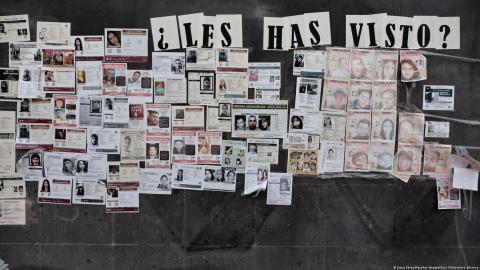
During 2025 in Mexico, at least 32 people were reported missing daily.
According to reports from the National Registry of Missing and Unlocated Persons (RNPDNO) and Amnesty International, in 2026 this figure increased considerably. Between January and May 2026, 53 daily disappearances were reported.
This suggests that the problem of disappearances in Mexico is worsening. Many of them are victims of organized crime. A clear example is the case of the “Izaguirre” Ranch in Teuchitlán, Jalisco, where More than 1,000 charred bone remains were found.
“Burning bodies” is a common method among hitmen to “disappear” the evidence of their crimes. Another is the dissolution in corrosive acids, which leave human remains almost unrecognizable.
The identification of these remains requires a complex and delicate process carried out in specialized laboratories. Although there are facilities in the country with the necessary technology such as the National Institute of Genomic Medicine (INMEGEN) and highly qualified non-public, the help of specialists in Germany has been required to be analyzed with greater precision.
“There are degraded samples that it is not possible to obtain a genetic profile here [en México] and they are sent to be analyzed abroad, to Frankfurt in this case,” says Everardo Ramírez, Native Person Search Commissioner in the State of Zacatecas, in an interview with DW.
“At the time, the MEIF (Extraordinary Forensic Identification Mechanism) signed a collaboration agreement with international organizations. There we met Maximilian Murck from the United Nations, who was the bridge between the prosecutor’s offices and the University of Frankfurt,” he details.
Of the thousands of missing people each year in Mexico, a significant number are found without identification in forensic services and mass graves.
“It is very likely that a large part of the missing people are already dead.it is the task of the Mexican State to identify these people. At the United Nations Population Fund (UNFPA), thanks to the support of Germany, Norway, the Open Society Foundation and Mexican government institutions, we implemented measures to identify these people,” Maximilian Murck, coordinator of the UNFPA Human Identification Program, who accompanies Mexican groups and prosecutors in the process of identifying human remains found, told DW.
The search process
Groups of family members, especially searcher mothers, are fundamental to the process of recognizing human remains found. The work begins with them and, in some states of the republic, they are the only form of peaceful civil resistance responsible for investigating, tracking, exhuming and reporting the discovery of human remains.
“When an anonymous person gives you references to a site, tells you ‘there is a grave over there’ or is very insistent that we search somewhere, our beetle – a member of the collective in charge of investigating possible sites of interest – does the geolocation, the investigation and then we go. We try to do it as quickly as possible and according to our budget,” Elizabeth Araiza, a member of the Buscador@s Zacatecas collective, explains to DW.
The work of search engine groups has become more visible thanks to social networksbut its beginnings date back to the 70s, when the first collective of organized mothers, “the National Front Against Repression” looked for their children, victims of the counterinsurgency policies of the Mexican State to repress political opponents and guerrilla movements during the so-called “Dirty War.”
“We, as families or groups, cannot do much, we search and report to the authorities. Afterwards, we deliver our genetic profile and information. We give the characteristics of our family and that is all we can do. They [la Fiscalía] They are responsible for the processing of samples,” explains Elizabeth Araiza.
When carrying out a survey, the collected samples are analyzed in local laboratories. In complex cases, when the sample is severely damaged, they are sent to laboratories with greater analytical capacity. One of these laboratories is located at the University of Frankfurt. in central-western Germany.
“Only enough is sent to obtain a genetic profile. They are grams, a complete bone is not sent.
Germany’s role
According to Maximilian Murck, Human identification is a long and expensive processas well as very specific for each case.
Obtaining the identity of a missing person through genetic analysis can cost between $500 and $1,000. There are charred, acid-damaged or “long-dated” samples (samples in an advanced state of decomposition) that must be analyzed in laboratories with technology not available in Mexico.
State prosecutors’ offices, such as those of Zacatecas and San Luis Potosí, have sent samples to be analyzed and identified in Germany.
A long way to go
Despite the preparation of Mexican experts and the binational cooperation between Germany and Mexico, the process of identifying human remains remains slow and in some cases non-existent.
“I believe that, yes, they are doing something, there are some results. But I also believe that the Prosecutor’s Office uses the excuse that the sample was sent to Germany to exonerate itself from its omissions,” comments Elizabeth Araiza.
“A lady looked for her son at the SEMEFO [Servicio Médico Forense] and they told him that it was not there, he constantly went to ask questions and had no answer. Eight months later they realized that their son’s body was always there,” says the member of Buscador@s Zacatecas.
“The great challenge in terms of identification is the flow of information between states. There is no obnoxious national genetics data” says UNFPA expert Maximilian Murck. “It must be recognized that prosecutors’ offices are implementing pilot programs to connect state databases. Once the 32 are connected, that will give more results,” he predicts.
The path to the truth remains uncertain for thousands of Mexican families. Although international cooperation opens up new possibilities and scientific advances make it possible to identify remains previously considered irrecoverable, The magnitude of the crisis far exceeds institutional capacity.
For search groups, each discovery is a mixture of hope and pain: hope to close a cycle, pain to confirm a definitive absence. But, as long as there is no solid, coordinated and transparent national strategy, The bodies will continue to accumulate in what has even been called a forensic disasterexperts warn, and families will continue searching with their own hands for what the State has not been able to find.
(chp)


