
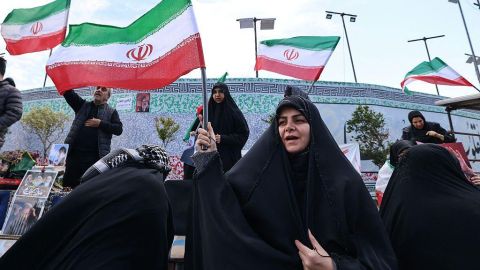
After hours in which the world was in suspense over Donald Trump’s threat that “an entire civilization” would die on Tuesday night, Iran and the United States agreed to a two-week conditional ceasefire, during which maritime traffic will be allowed through the Strait of Hormuz.
The American president announced the agreement through a publication on his social network Truth Social in which he reported that he agreed to “suspend bombings and attacks against Iran for a period of two weeks.”
He also said it was subject to the reopening of the Strait of Hormuz, a crucial shipping route for oil and other Gulf exports.
Iranian Foreign Minister Abbas Araghchi confirmed minutes later that Iran would accept the ceasefire agreement and reopen the strait “if the attacks stop.”
“For a period of two weeks, safe passage through the Strait of Hormuz will be possible,” Araghchi clarified.
Negotiations between the US and Iran are being mediated by Pakistani Prime Minister Shehbaz Sharif.
“With utmost humility, I am pleased to announce that the Islamic Republic of Iran and the United States of America, together with their allies, have agreed to an immediate ceasefire everywhere, including Lebanon and elsewhere, EFFECTIVE IMMEDIATELY,” Sharif wrote.
Despite this, attacks continued to be reported in Iran, Israel, Bahrain, Qatar, the United Arab Emirates and Saudi Arabia on Tuesday night.

Sharif’s message arrived just 10 minutes before the maximum deadline for reaching an agreement that Trump had established.
If the ceasefire had not been achieved, Trump had threatened massive destruction of civilian infrastructure in Iran, including bridges and power plants.
Specifically, he threatened that he could eliminate Iran “in a single night” and that “an entire civilization will die, never to return.”
These statements provoked the condemnation of the frequent secretary of the United Nations, António Guterres, and of Pope Leo XIV.
For its part, Israel supported the ceasefire agreement through a statement.
“Israel supports President Trump’s decision to suspend attacks against Iran for two weeks, provided that Iran immediately opens the straits and stops all attacks against the United States, Israel and countries in the region,” the Israeli statement said.
It is unclear to what extent Netanyahu was involved in Trump’s decision-making process.
For the Israeli government, however, the ceasefire does not include its operations in Lebanon.
After the attacks on Iran by Israel and the United States began on February 28, the armed forces attacked Lebanon, with special force in the south of the country, under the argument that it was fighting the armed group Hezbollah, backed by Iran.
A 10-point diagram and the negotiations to come
In his post on Truth Social, Trump reported that he had received “a 10-point proposal from Iran,” which he considered “a viable option on which to negotiate.”
The diagram, published by Iran, contains, among other things, the complete cessation of the war in Iran, Iraq, Lebanon and Yemen; the “full commitment” to lift sanctions against Iran; the release of Iranian funds and frozen assets held by the United States; and “full payment of compensation for reconstruction costs.”
It also states: “Iran is fully committed to not attempting to possess nuclear weapons.”
“Iran’s victory on the ground will also be consolidated in political negotiations,” Tehran’s Supreme National Security Council declared in a statement.
In turn, Trump published a new message on Truth Social this Wednesday morning where he affirms that the United States will collaborate with Iran, a country that, “as we have verified, has experienced a regime change that promises to be very productive.”
Trump assured that Iran will not enrich uranium and that the United States will work with Tehran to unearth and eliminate all nuclear remains (from B-2 bombers) buried deep underground.
He added: “Nothing has been touched since the attack. We are and will continue to negotiate with Iran to reduce tariffs and sanctions.”

According to Pakistan, talks between the US and Iran will begin in Islamabad next Friday “to continue negotiating and reach a final agreement that resolves all disputes.”
White House Press Secretary Karoline Leavitt acknowledged that discussions are underway about the possibility of meeting in person, but said that “nothing is final until it is announced by the President or the White House.”
It is not going to be an easy negotiation, explains the Washington correspondent for the BBC Persian service, Khashayar Joneidi, because trust between the parties is very weakened.
The United States and Iran appear to have contradictory positions on what this ceasefire entails.
Iran and the United States have held two rounds of talks last year. On both occasions, military tensions escalated amid the negotiations.
Traffic through the Strait of Hormuz, which Iran will want to continue to control to some extent, and the Iranian nuclear program are surely going to be points of contention.
“It’s going to be a very difficult two weeks,” Joneidi says.

The dispute for victory
Despite this, both parties appeared victorious after the agreement was announced.
Iranian state television claimed that the US “accepted Iran’s conditions to end the war” and called the deal “a humiliating retreat by Trump.”
In a statement, Iran’s Supreme National Security Council said that the country had achieved almost all of its objectives in the war and that the enemy (the US) was facing “a historic failure.”
And he noted that the upcoming negotiations in Islamabad will allow “Iran’s victory on the battlefield to also be consolidated in political negotiations.”
According to Khashayar Joneidi, this war represented an existential threat to the Iranian regime.
Therefore, they see the fact that the Islamic Republic has survived after more than 30 days of attacks as a victory.
Trump, for his part, said he accepted the agreement given that “we have already met and exceeded all military objectives, and we are very advanced in a definitive Agreement on long-term PEACE with Iran, and PEACE in the Middle East.”
Later, in an interview with the AFP agency, he said there was no doubt that the US had achieved a “complete and total victory.”
As soon as news of the agreement became known, oil prices plummeted in the markets, which relieved the pressure that had been increasing on Trump from citizens dissatisfied with the high cost of fuel that the war had produced.

Is there really any progress?
Analysis by Tom Bateman, BBC correspondent for the US State Department.
Pakistan’s intervention has given both Donald Trump and Iran a ladder to back down.
It comes after an extraordinary and unprecedented threat by an American president to destroy infrastructure and “end civilization in Iran” in a way that could have constituted war crimes.
We are still trying to clarify what exactly has been agreed upon. Trump says Iran has agreed not to pursue a nuclear weapon, but that has always been Tehran’s position.
The moment is significant. It allows Trump to say he has bought himself some time, but with the implicit threat of a return to the use of force.
So, in a way, we are back to square one.
This is American diplomacy. As Pete Hegseth put it: “We deal with bombs.”
The problem is that the Iranians have always been absolutely clear that their ultimate goal is to deter the Americans from this cycle of diplomacy followed by bombing of Tehran.
So this may not be a long-term solution, but it certainly represents a step back from the situation we were in just a few hours ago.

click hereto take into story more stories from BBC News Mundo.
Subscribe hereto our new e-newsletter to receive a selection of our best content of the week every Friday.
You can also follow us on YouTube, instagram, TikTok, x, Facebookand in our whatsapp channel.
And remember that you can receive notifications in our app. Download the latest version and activate them.
- ‘We’re sinking deeper’: Iranians prepare for attacks on their country’s civilian infrastructure as Trump’s deadline approaches
- “The Iran ceasefire deal is a temporary victory for Trump that could come at a high cost”
- 8 contributions of ancient Persian culture to our daily lives


