
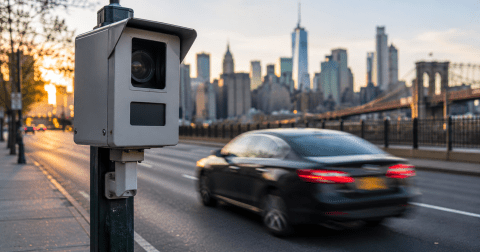
New York surprised this week with an innovative measure against repeat drivers for speeding. The state will begin to require installation of limiting devices in the vehicles of those who accumulate a repeated history of violations captured by cameras, a decision that points directly to the so-called tall speeders.
The measure is part of the state budget promoted by Governor Kathy Hochul and seeks to attack a small group of motorists who, according to authorities and road safety organizations, concentrate a disproportionate part of the risk on streets and routes.
The new rule will reachdrivers who accumulate 16 or more speeding violations detected by cameras in a 12-month period. In these cases, they must install an intelligent assistance system that uses GPS to recognize the speed limit of each zone and prevent the vehicle from exceeding it.
The focus is not on who received an isolated fine, but on who turn speeding into a repeated behavior.
“New Yorkers deserve to feel safe when they cross the street, take their children to school or drive to work,” Hochul said when presenting the initiative.
What happens if a driver does not comply
The consequences will not be minor. Those who ignore the obligation to install the device could face fines of between $1,500 and $2,500, in addition to possible suspension of the vehicle registration. There will also be sanctions for those who try to manipulate or disable the system.
Although the measure still needs operational implementation, the political message is clear: New York wants to move from financial fines to concrete restrictions for those who insist on driving dangerously.
Why New York is targeting tall speeders
The initiative comes after years of pressure from organizations demanding stricter measures against drivers with long histories of violations, especially near schools.
In New York, speed cameras became a central defense watch over tool, but the debate changed when it was detected that some vehicles were accumulating dozens—and even hundreds—of fines without changing their behavior.
For road safety advocates, the problem is not the majority of drivers, but rather a minority of repeat offenders who continue driving as if economic sanctions did not exist. The new law seeks precisely to intervene before a tragedy occurs.
Other states are also moving forward with similar measures
New York is not the only state that is watching the technology as a way to stop the most dangerous drivers. In recent years, several jurisdictions have begun to debate or approve measures based on intelligent speed assistance systemsknown as ISA for its acronym in English.
Virginia was one of the most relevant cases: A law will allow judges to order the installation of these devices in vehicles of repeat drivers for reckless driving, as an alternative to more traditional sanctions. The measure is scheduled to begin in July 2026.
Washington and the District of Columbia They also appear among the jurisdictions that have advanced with regulations linked to these systems, while in other states, such as Iowa and Pennsylvanialegislators and road safety organizations are promoting similar proposals to confront the so-called tall speeders.
The trend shows a change in approach: it is no longer just about issuing fines or adding points to the license, but about specifically limiting the ability to drive above the permitted limit when there is a repeated history of violations.
Continue reading:
What are the points on your driver’s license and how many could lose it in California
California Highway Patrol begins Maximum Surveillance Period
Union drivers push bill against autonomous vehicles in California


