
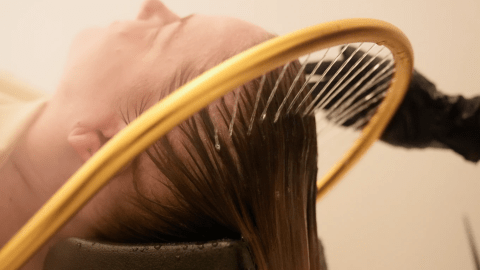
Hair spas have their roots in Japan, based on ancient practices that combine massages and herbal tinctures. Since their introduction into Japanese salons in the 1990s, they have gained popularity in Asia and are now proliferating in the United States.
Typical hair spa sessions last between 60 and 90 minutes, beginning with a scalp inspection, followed by deep cleansing, exfoliation, and massages of the head, face, and neck.
Many services include essential oils, conditioning masks, and aromatherapy in relaxing environments.
Benefits of hair spas
Some hair spas make claims about health benefits, such as stress relief and treating scalp conditions.
Experts warn that it is preferable to consult a dermatologist for hair health problems. Spas can be complementary to medical treatments, but should not replace them.
Customer experiences
Clients reported to Associated Press (AP) rejuvenating and relaxing experiences, highlighting the effectiveness of these treatments in relieving accumulated tension, especially for those who spend long hours in front of a computer.
“Normally when I go for a massage, they focus on my back, and I always wish they massaged my head more, especially my face and neck,” said Karena Kong, a regular client at Nen Head Spa in San Francisco. “When I saw that they offered a 90-minute massage for just the head, face and shoulders, it seemed like a great way to focus on the areas I like the most.”
“I always fall asleep and take a nap, because it’s very relaxing,” she told AP Crystle Vitari, who first visited a hair spa during a trip to South Korea and finds it “rejuvenating.”
Differences with conventional treatments
The treatments of hair spa They tend to focus more on the scalp, relaxation and comprehensive health of the hair, while conventional hair treatments usually seek a faster aesthetic result in the hair fiber, such as softness, shine or superficial hydration.
In total, the hair spa works more “from the roots”, and the conventional treatment more “on the hair”.
Main differences
- Approach. The hair spa prioritizes the health of the scalp; Conventional treatments focus on improving the appearance of the hair.
- Aim. The hair spa seeks a more comprehensive and lasting benefit; Traditional treatments usually give visible, but more temporary results.
- Techniques. The hair spa usually includes deep cleansing, massages, aromatherapy or stimulation of circulation; Conventional treatments use more masks, ampoules, keratins, and cosmetic products.
- Experience. The hair spa is usually more sensory and relaxing; Conventional treatment is usually more direct and functional.
- Ingredients and method. The hair spa is usually presented as a more pure or holistic option, while conventional treatments may depend more on intensive cosmetic formulas.
When is each one appropriate?
- Hair spa: If you have an oily, radiant scalp, with product build-up, tension or are looking for a wellness experience in addition to hair care.
- Conventional treatment: if you want to quickly improve shine, frizz, softness or repair hair after chemical or thermal damage.
Think of the hair spa as just another treatment preventive and globaland in conventional treatment as a more solution cosmetic and punctual. Both can complement a hair routine well, but they do not fulfill exactly the same function.
You may also be interested in:
· When should you get a mammogram? The importance of considering individual risk
· How you can verify health and wellness claims that proliferate on social media
· Coffee with egg, the drink that captivates social networks


