
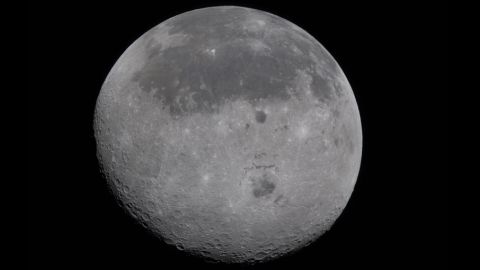
The four astronauts of NASA’s Artemis II mission are returning home after a dramatic lunar flyby that took them farther from Earth than any other human beings.
During their trip, the crew lost contact with Earth for 40 minutes, something scientists had already warned would happen.
The most exciting moment of the trip occurred this Monday when the astronauts on the mission became the first humans in more than 50 years to see the hidden side of the Moon with their own eyes.
Space probes from China and India have already explored this mysterious “hidden side”, but now they observed it and recorded it in images for further analysis.
What we are seeing is “really difficult to describe,” said mission pilot Victor Glover when he managed to communicate with NASA again.

Commander Reid Wiseman added his observations: “It is simply indescribable. No matter how much we look at it, our brain cannot process this image,” he said.
“It’s absolutely spectacular, surreal… there are no adjectives, I’m going to have to invent some new ones, there are no words to describe what we see through this window,” he added.
And the photos they have sent to date reflect these comments.
Orion has a total of 32 cameras and imaging devices (15 on the probe and 17 in the hands of the crew).

After the flyby, US President Donald Trump contacted the Orion crew to congratulate them, and ask them what the most unforgettable part of the day had been.
Wiseman responded: “We saw things that no human being has ever seen, not even the Apollo program, and that was amazing to us.”

What the hidden side reveals
During the flyby, the crew witnessed a complete solar eclipse, which Glover described as “science fiction” and “unreal.”
He also talked about what the solar corona looks like.
“The Sun has hidden behind the Moon and the corona is still visible; it shines intensely and creates a halo that almost completely surrounds it. But when observing the Earth, its brightness can already be seen.”
“The Earth shines with an astonishing intensity and the Moon seems to be right in front of us. This black orb in front of us now is not absolute black, but a grayish tone that blends into the darkness. We can see stars and planets behind (…) It is a truly impressive sight,” commented the mission pilot.

Nicola Fox, NASA’s Chief of Science, commented that the Artemis II crew also saw several “new, small craters” while observing the far side of the Moon.
As Fox told BBC’s At the Novel Time, the craters appeared as “bright spots” and were visible to the crew as a series of colors, including shades of brown and blue.
The astronauts also described the line that divides the illuminated side from the dark side of the Moon as a “jagged edge” due to the craters of the celestial body.
The astronauts are expected to land on April 10 in the Pacific Ocean at 8:07 p.m. Eastern Time.


click hereto ask more stories from BBC News World.
Subscribe hereto our new newsletter to receive a selection of our best content of the week every Friday.
You can also follow us on YouTube, instagram, TikTok, x, Facebookand in our whatsapp channel.
And remember that you can receive notifications in our app. Download the latest version and activate them.
- Artemis II astronauts become the humans who have traveled the furthest in space: the critical 40 minutes in which they lost contact with Earth
- See the hidden side of the Moon and go where humanity has never been before: the records that NASA’s Artemis missions seek to break
- The spectacular images of Earth captured by the crew of Artemis II, which is already halfway to the Moon


